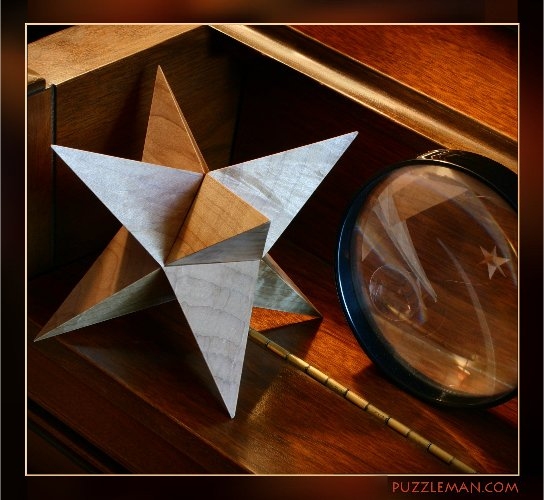
Primordial Mechanisms
Primordial Mechanisms is the foundational, still-active branch of Arteanity documenting Viktor Genel’s investigation of working three-dimensional geometry since 1981. Historically circulated as puzzles, these mechanisms are classified by the archive through structure, transformation, and motion rather than primarily as games or problems to be solved.


Primordial Mechanisms began in 1981 with an encounter with the Rubik’s Cube.
The cube was compelling not as a problem to be solved, but as a concealed three-dimensional mechanism: an object whose parts could move extensively while the whole remained intact.
That encounter initiated a sustained investigation into working geometry.
The resulting objects were commonly presented as puzzles because the puzzle field offered a direct means of producing and circulating them.
Yet puzzling, difficulty, and trickery were never the central concern.
The mechanisms were conceived as material investigations of geometry - structures in which motion followed from spatial relations, intersections, symmetry, and the organization of parts.
The branch developed through:
inventions, prototypes, manufactured objects, diagrams, certificates, digital models, and written inquiry.
Its first major documented threshold was the 1987 Soviet Certificate of Invention associated with Puzzle of Puzzles, a metamorphic mechanism capable of assuming numerous spatial configurations.
Production reached its greatest intensity around the turn of the twenty-first century.
At least six series of collectors’ puzzles were produced by the internationally recognized puzzle manufacturer Wayne Daniel.
The inquiry subsequently entered an intermediate stage called GeoMachine, during which several designs were realized through three-dimensional printing.
Although the principal direction of Arteanity moved elsewhere - first through literature and monumental work, then through Deutilization and MeconoMorph, and most recently through Somacentric Trajectilery - Primordial Mechanisms never became entirely dormant.
It has continued in parallel with these later branches, generating new forms and procedures while retaining its foundational concern: the investigation of geometry, structure, constraint, and emergence through working three-dimensional form.