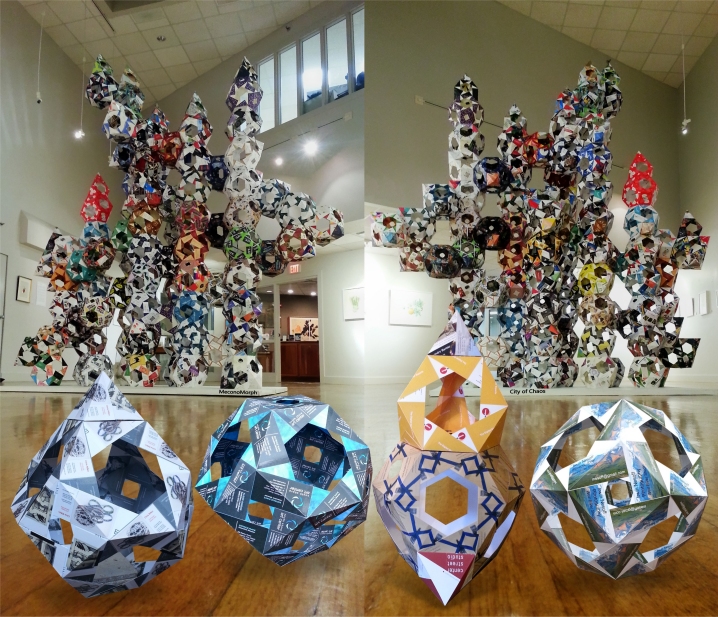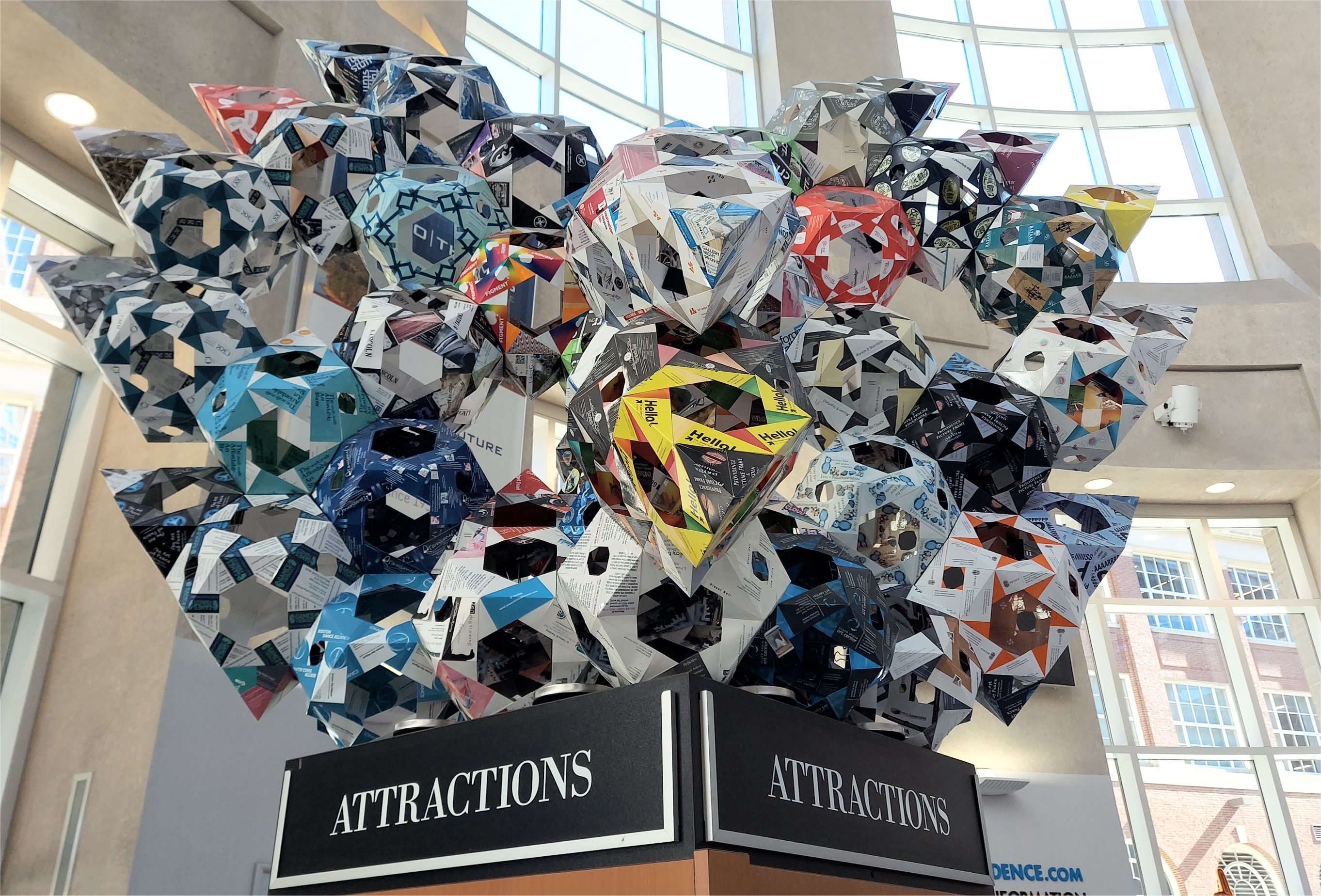
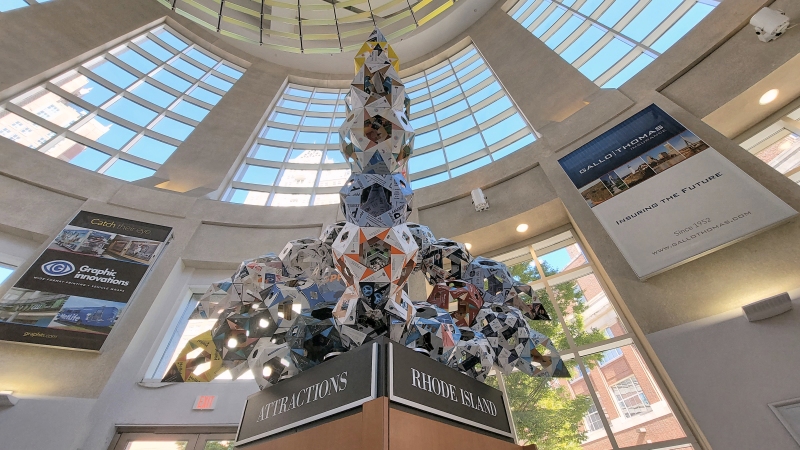
Raptor was a long-lived MeconoMorph artifact assembled from modular units made from folded, permanently joined business cards. Emerging at the Providence Visitor Center in 2019 and persisting through 2025, it grew and changed without requiring a fixed geometry. As a MeconoMorph “Seed,” Raptor also functioned as a point of further propagation: thousands of cards were contributed through the installation, only some entering Raptor itself while many became new modules used elsewhere in the wider MeconoMorph system.
Raptor was one of the longest-lived artifacts of the MeconoMorph corpus.
Its assembled life extended from 2019 through 2025. Unlike a fixed sculpture, Raptor did not depend on an immutable geometry or a permanently closed inventory of material. It persisted as a named MeconoMorph incarnation while its modular body could grow, change, and respond to the circumstances around it.
Its documented public history begins at the Providence Visitor Center in January 2019.
A contemporary Motif Magazine account recorded the installation at the Providence Convention Center beginning January 23, 2019. The writer described the structure as airy, hollow, geodesic, and visually suggestive of both coral and crystal, opening the article with the observation that it perched “raptor-like” above the visitor-center kiosk. The same account documented sustained visitor attention and the continuing contribution of business cards.
At that stage Raptor was described as a MeconoMorph “Seed.”
Within MeconoMorph, Seed does not name a particular artifact type or a fixed incarnation. It describes a manifestation that initiates a new spur of growth. Raptor functioned in precisely this way: its presence generated further participation, material, modules, and subsequent activity beyond the boundaries of the artifact itself.
Raptor was constructed through the modular logic of MeconoMorph.
Business cards were folded and permanently joined within individual modules. Those modules could then be assembled, added, removed, and reconfigured without requiring the artifact to remain materially or geometrically static. The identity-bearing structure therefore existed at two scales at once: the named artifact Raptor and the persistent modules from which its changing body was formed.
The thousands of cards collected around Raptor should not be understood as thousands of cards simply added to Raptor.
Only a portion entered the artifact itself. Much of the accumulated material was used to construct new modules that subsequently entered other MeconoMorph manifestations and artifacts. Raptor therefore operated not only as an evolving artifact but as a productive node within the larger MeconoMorph network.
This distinction is central to the history of MeconoMorph.
Artifacts can appear, grow, change, and disappear while modules and material relationships continue across the system. The history is therefore not a sequence of isolated sculptures. It is an interconnected material trajectory in which one manifestation can generate the conditions, modules, and resources from which others develop.
Later published accounts explicitly identify the Providence work as Raptor.
Entertainment Post described Raptor as the largest MeconoMorph incarnation at the Providence Visitor Center, while NY Weekly later placed Raptor within an unfolding network of evolving MeconoMorph installations. These articles are retained as documentary evidence of the artifact’s public history and reception; their promotional or sustainability-oriented interpretations should not be taken as the canonical definition of Deutilization.
Raptor’s unusually long 2019–2025 existence makes it a particularly important record within the corpus.
Its history demonstrates that a MeconoMorph artifact can maintain identity through substantial material and geometric change. Its eventual disappearance as an assembled configuration does not reduce it to an exhibition record or a former location. Raptor remains an artifact of the MeconoMorph corpus whose trajectory can be reconstructed through surviving modules, photographs, publications, events, exhibitions, and other records.