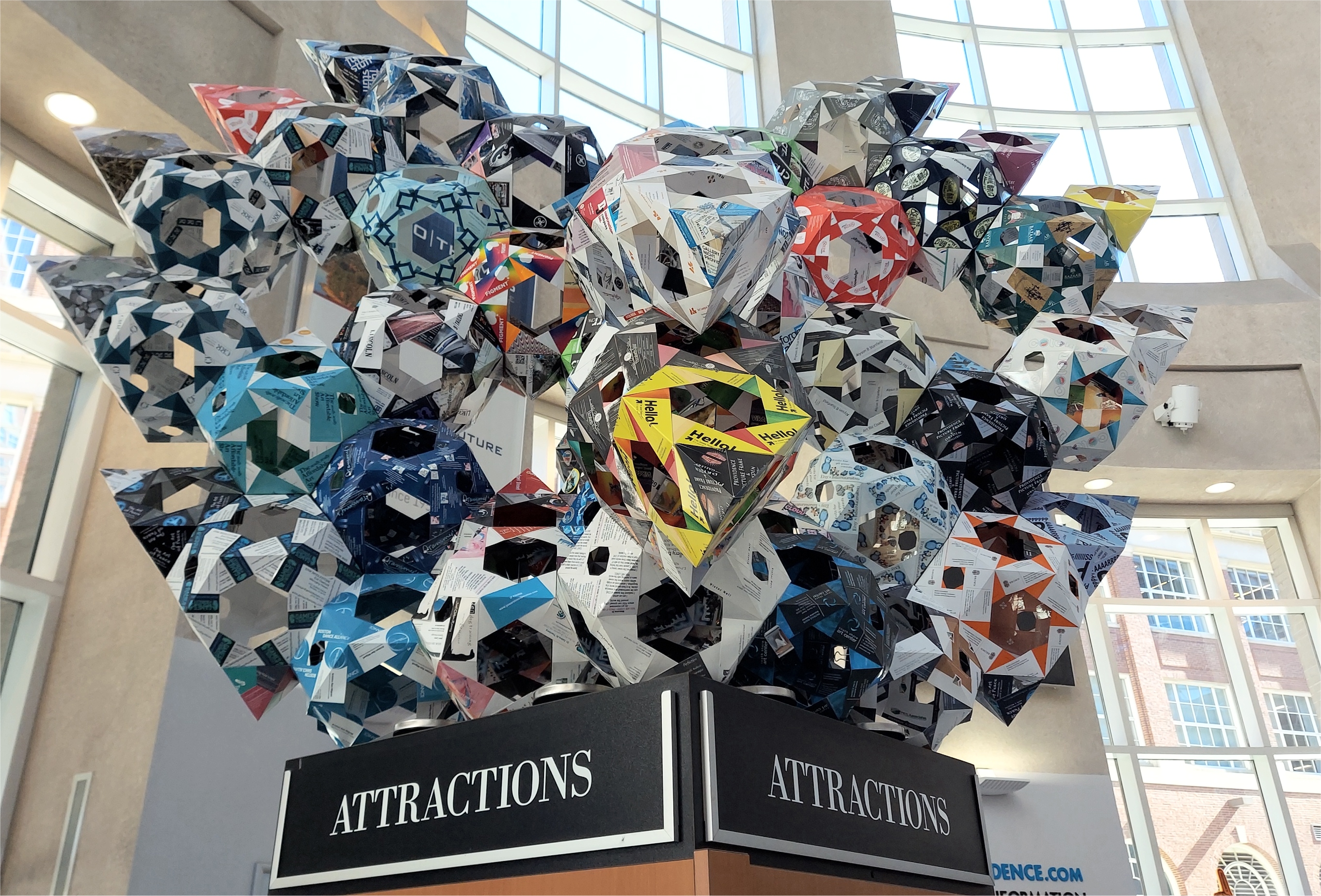
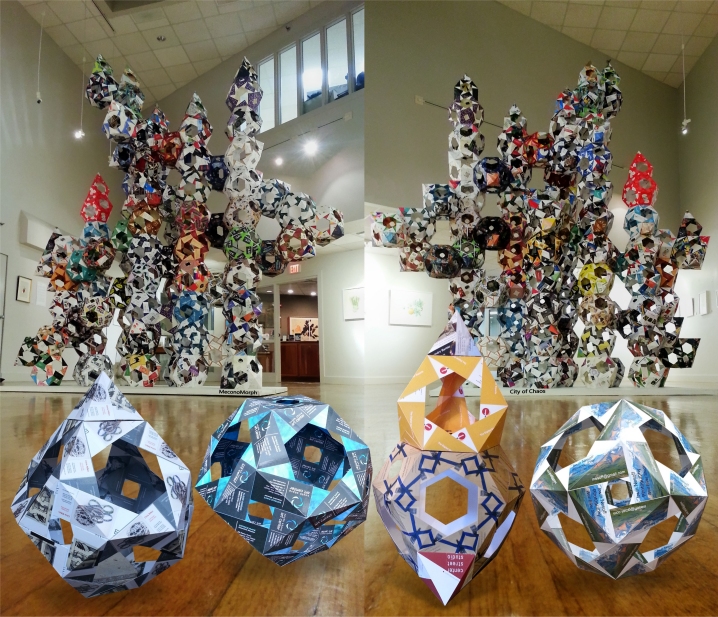
The MeconoMorph corpus gathers conceptual works, named forms and protocols, authorized incarnations, persistent modules, events, and records produced through the evolving MeconoMorph system within Deutilization. Initiated in 2013, the system transforms folded business cards into repeatable Mecons and expandable three-dimensional structures.
MeconoMorph is a participatory initiative and evolving modular system within Deutilization, initiated in 2013. It has no single definitive physical embodiment. It manifests through multiple incarnations whose shapes, dimensions, constituent modules, and assembled duration may differ. The MeconoMorph corpus gathers these incarnations together with associated works, modules, protocols, events, and documentary records.
Three levels must be distinguished: MeconoMorph as the system; an incarnation as a particular, historically situated realization; and the Mecons that compose its modular body. An incarnation may be assembled, enlarged, altered, dismantled, or followed by another configuration. No individual incarnation exhausts the identity or possibilities of MeconoMorph.
Mecons are atomic structural units within the system. Each is a complete module constructed from folded, permanently joined business cards. Atomic describes the operative boundary of modular construction: the complete Mecon participates as a unit in larger assemblies. It does not mean that its constituent cards are physically inseparable under every condition.
Mecons are structurally interchangeable within compatible assemblies. A module can be replaced by another suitable Mecon without necessarily changing the identity of the encompassing incarnation. Interchangeability does not erase material differences: printed identities, colour, wear, fabrication, and previous participation remain part of each module's particular history.
MeconoMorph's continuity is not tied to the permanent preservation of one configuration or one inventory of modules. A named incarnation may also persist through changes to its form and constituent units. The persistence of the system, however, is distinct from the continuation of any particular incarnation. A similar-looking reassembly does not by itself establish that the same historical incarnation has returned.
Modules can survive the dismantling of an incarnation and participate in later constructions. Their movement establishes material provenance across the corpus without necessarily establishing formal descent between the incarnations. City of Chaos, for example, incorporated modules previously used in Sand Clock and other configurations; Raptor functioned as a Seed whose collected cards supported module production beyond its own changing body.
Business cards enter MeconoMorph through interruption of their prescribed service as instruments of professional identification and exchange. Their material capacities remain active: folding, joining, support, and geometric combination enable further construction. Printed information may also remain visible. Deutilization therefore concerns an assigned service rather than the abolition of every physical capacity or every subsequent use.
MeconoMorph makes the distinction between interrupted assignment and continuing generative capacity materially apparent. Its modular organization permits further formations without requiring a single final shape. Particular incarnations can arise through different procedures; City of Chaos is documented as an open-ended assembly whose form emerged during installation. That procedure should not be assumed for every incarnation.
Participation is constitutive of MeconoMorph. Contributors supply card material that can enter new Mecons, while public installations and invitations create occasions for further involvement. Contributions need not be incorporated into the particular incarnation at which they are collected: Raptor's Seed role, for example, supported module production for other constructions. The initiative therefore extends beyond the visible assembly to the continuing relationships and material contributions that enable its manifestations.
Outreach enables this participatory continuity by bringing the work to wider audiences and inviting contributions. An encounter with a particular incarnation can thus become an entry into the initiative's continuing activity.
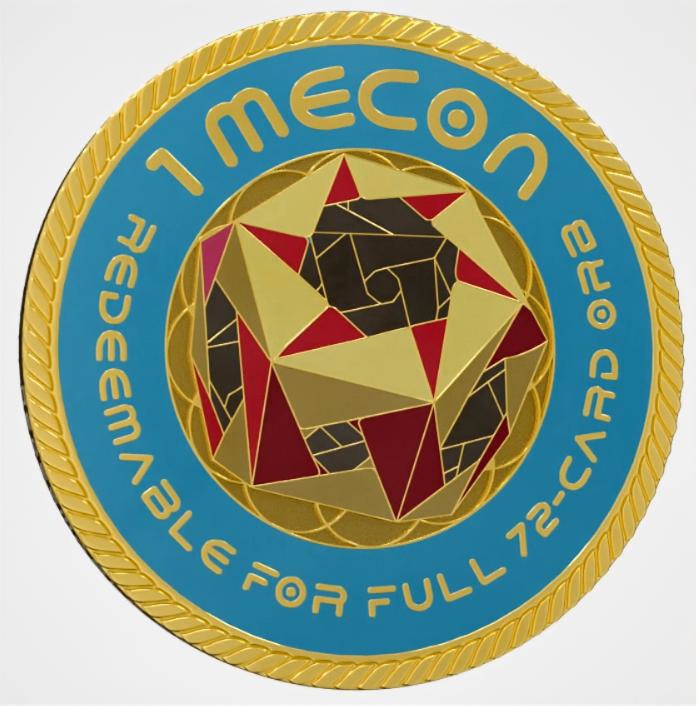
The Mecon Coin introduces a symbolic denomination into this material system. The existing coin record specifies that 1 Mecon carries a right to receive one complete 72-card Mecon Orb or two smaller Mecon Orbs. The coin is a separate artifact and an access mechanism; it is not itself a construction module. Denomination, redemption, and modular assembly are related operations, but the redemption options should not be treated as a universal measure of geometric size or an external monetary equivalence.
In a June 15, 2013 interview with Michael Luchies, Genel already described MeconoMorph through multiple incarnations and envisioned replacement of older Mecons within a continuing system. Later records of Sand Clock, City of Chaos, and Raptor provide specific material histories through which this distinction between system, incarnation, and module can be examined.