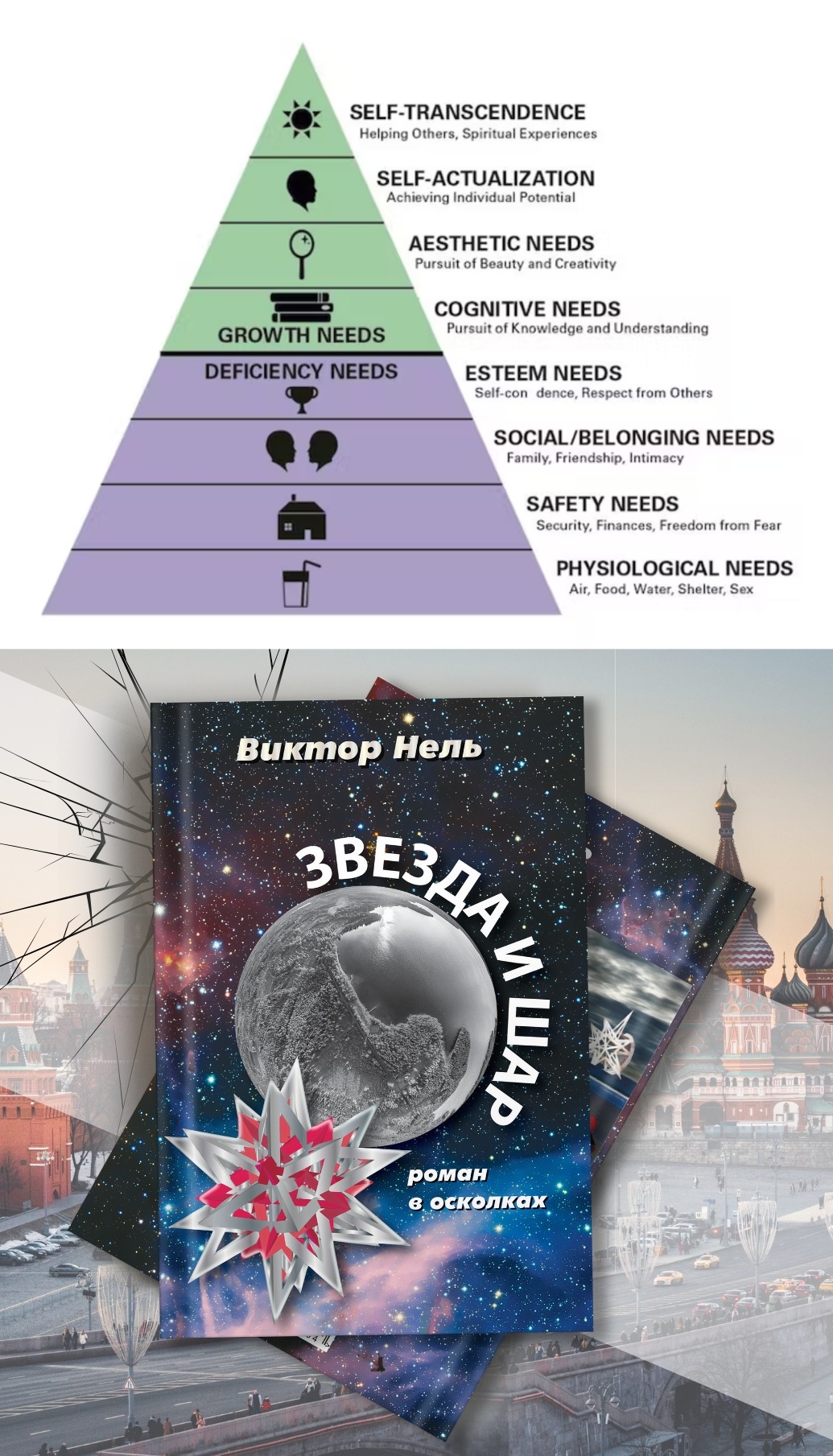
Beyond Level Zero: Dimension Z and Maslow’s Self-Transcendence
Dimension Z in The Star and the Sphere can be read as an independently developed literary model of self-transcendence. Kamensky’s diary distinguishes accumulation from a change in the horizon of a life; the meadow offers movement beyond prescribed destinations; attention to clouds gives that freedom a positive content. Maslow’s later account of absorbed, noninstrumental attention provides a particularly close comparison. Social success is not equated with his self-actualization. Genel recognized the connection on November 10, 2026, decades after the novel’s development. Related material works trace the later investigation of assigned purpose within Arteanity.
Level Zero is a literary orientation, not a rung in a needs pyramid or a diagnosis of people. Prestige does not establish Maslovian self-actualization, and rejecting convention does not alone establish self-transcendence. The strongest correspondence concerns the altered authority of identity, reward, and usefulness over attention. The novel’s evaluative distinction between Level Zero and Z also deserves scrutiny: a new orientation can become a claim to superiority. Its full narrative arc and the Star and Sphere transformations still require closer examination. Independent development is reported by the author; it does not establish priority over Maslow. Related corpora and artifacts document later practices, not psychological proof.
A Recognition Across Decades
On November 10, 2026, Viktor Genel recognized a connection between Dimension Z in his novel Звезда и Шар (The Star and the Sphere) and Abraham Maslow’s account of self-transcendence. His formulation was direct: Dimension Z is what Maslow calls self-transcendence. This record takes that recognition seriously by examining the literary passages that support it, while preserving the difference between an author’s present understanding, a character’s speech, and a psychological theory.
According to Genel’s account, he first encountered Maslow’s work on November 7, 2026. The novel and its vocabulary of Level Zero and Dimension Z therefore precede that encounter. This establishes the sequence of his reported reading history, not priority over Maslow’s publications of 1969. The comparison concerns independent convergence. It does not propose that Maslow influenced the novel, or that the shared letter Z establishes a historical relationship.
The earlier Connections essay considered Maslow alongside the Geometer, Deutilization, and Preutilization. This record has a different center: the main novel’s account of a life that can become increasingly successful without leaving the plane on which its purposes have already been assigned.
Level Zero Includes Success
Kamensky’s diary begins with the effort required simply to remain afloat. Food, shelter, clothing, and recreation consume the energies of a lifetime. But its argument does not stop at deprivation. Some swimmers barely survive; others possess considerable power. The disturbing observation is that greater power can be spent maintaining the same condition.
The diary follows a sequence of substitutions: a poor dwelling becomes an expensive apartment, ordinary furnishings become prestigious ones, local clothing gives way to imported brands, public transport to a car, and routine meals to restaurants. Advancement through academic and military ranks joins the sequence. Kamensky writes: «Бодро двигать в доктора и академики, или в майоры и генералы. Лишь бы не замечать ничего, кроме уровня ноль».
In a working translation: “Advance briskly toward doctorates and academies, or toward the ranks of major and general. Anything, so long as one notices nothing beyond Level Zero.” The irony distinguishes visible advancement from a change in the horizon that gives advancement its meaning.
Level Zero is consequently not a synonym for poverty, low intelligence, low social rank, or an absence of accomplishment. It can accommodate extraordinary effort and recognized achievement. Its defining limitation is that the established field of purposes continues to supply the entire measure of a life.
Movement Without Displacement
The diary’s recurring images are swimming to remain afloat and running in place. These are images of real expenditure without the kind of displacement the speaker seeks. The distinction matters: the achievements are not imaginary, but their accumulation need not alter the person’s relation to existence.
The text intensifies the image by describing people weighing themselves down with objects so that they will not leave their familiar condition. Acquisition becomes more than possession. It can become a means of securing oneself against the disorientation that another dimension would introduce.
This is a literary diagnosis spoken through Kamensky, not an empirical classification of all materially comfortable people. The comparison should preserve its satirical force without treating a fictional voice as a validated psychological instrument. Nor should it turn survival work into a moral failure. The diary explicitly distinguishes those struggling to stay above water from those who have the resources to imagine another movement.
Dimension Z Changes the Terms of Progress
In this reading, Dimension Z is not the next prize within Level Zero. It names a direction for which Level Zero’s measures are insufficient. A promotion can change one’s location within an institution; a different relation to the institution’s authority over one’s purposes changes something else.
This gives the spatial metaphor its precision. Additional movement within a plane does not produce the coordinate that the plane excludes. Greater speed, wealth, rank, or visibility cannot by themselves establish departure from it. The question is not how far someone has advanced, but what has been accepted as the whole field in which advancement is possible.
Genel’s present identification of Z with self-transcendence is most persuasive at this point. It recognizes a shift beyond the familiar self as an occupant of assigned positions and a pursuer of recognized rewards. The novel makes that shift imaginable through spatial language before the later encounter with Maslow supplies a neighboring psychological vocabulary.
Maslow Beyond the Simplified Pyramid
In “Various Meanings of Transcendence,” Maslow discusses several departures from familiar limitations: cultural identification, dependence on others’ appraisals, confinement to roles, and restriction to what is immediately actual. He also discusses commitments and identifications extending beyond the individual. His account is plural rather than a single narrowly defined final step. [1]
His “Theory Z” distinguishes self-actualizing people for whom transcendent experience is central from those for whom it is less prominent. He explicitly presents the exploration as preliminary and acknowledges that such experience is not confined neatly to a single category of people. [2]
The familiar pyramid diagrams offer a useful prompt for recognition, but their clean upward sequence can conceal these complications. They should not determine the interpretation of the novel. The relevant comparison concerns changes in the scope of identity, value, and experience, not a claim that every character occupies a measurable rung.
Level Zero therefore cannot be mapped directly onto the lower tiers of a needs diagram. It includes socially celebrated forms of fulfillment. A table matching each fictional character to a psychological level would produce an appearance of precision the present evidence does not support.
Achievement, Self-Actualization, and Transcendence
The novel’s criticism of prestigious success does not by itself demonstrate a movement beyond Maslow’s self-actualization. Maslow’s self-actualizing person is not simply someone with an impressive career. In “Theory Z,” he describes a strong, authentic identity and then asks what transcendent experiencing adds to it. [2, discussion 19] A successful occupant of Level Zero cannot therefore be classified automatically as a self-actualizer.
This distinction sharpens the comparison. The diary shows why promotion within an accepted order can leave its authority unquestioned. Dimension Z supplies a literary model for changing one’s relation to that order. Whether a particular passage concerns autonomy, fuller realization of a person’s capacities, or transcendence beyond self-concern must be established from what becomes possible there.
The working title’s “beyond” names departure from Level Zero. It does not announce that the novel surpasses Maslow. The discovery is that a literary dimension developed independently can make a related psychological problem unusually tangible: a life can acquire more within its existing coordinates without acquiring another direction.
The Meadow and the Carrot
Near the novel’s end, Sasha asks Kamensky where to go. The reply rejects the assumption of a ready-made path: «Путей нет, есть широкий луг. По нему можно идти куда угодно, петлять и возвращаться. А лучше — шагать в сторону. Избегай колеи. Настоящее всегда в стороне, впереди только морковка».
A working translation reads: “There are no paths; there is a broad meadow. You can walk anywhere across it, wander, and return. Better still, step to the side. Avoid the rut. What is real is always off to the side; ahead there is only the carrot.”
The carrot promises a destination whose pursuit continually renews itself. The meadow changes the geometry of the problem: movement need not derive its legitimacy from an already established track. This is why the passage should stand at the center of the connection rather than appear as a decorative quotation.
The novel offers an alternative to the simplified image of a compulsory upward ladder. This is not in itself a disagreement with Maslow’s later, more qualified account. Its invitation is lateral and exploratory. It permits wandering and returning. Z is not necessarily a summit from which one permanently looks down on everyone else. It can name the opening of a field that inherited routes had concealed.
The Question “Why?”
The dialogue becomes more explicit when Kamensky asks Sasha to recognize the question already troubling him. Sasha offers «Зачем?»—“What for?” or “Why?” Kamensky does not supply a final answer. He asks why Sasha has begun asking.
Sasha’s replies concern his inability to remain a link in the chain, his refusal to remain made of the same thing, and exhaustion with following the beaten track to the watering place. He finally condenses the condition: «Темно и пусто на уровне ноль»—“It is dark and empty at Level Zero.”
The distinction between these two questions is consequential. Asking which destination to choose can leave the authority of destinations intact. Asking why the existing destinations no longer suffice makes that authority available for examination.
Yet the passage does not certify a completed transcendence. Kamensky says Sasha is ready to search for an answer. The novel preserves a threshold of readiness, uncertainty, and pain. Recognizing the insufficiency of a plane is not the same as having established a settled life beyond it.
Beyond the Role, Beyond the Self
The passages strongly support a reading of Z as release from inherited roles and measures of success. A further question concerns the meaning of “self” in self-transcendence. Freedom from an assigned identity and movement beyond personal self-concern can meet, but they need not coincide.
A person can reject convention in pursuit of an enlarged personal distinction. That rejection alone does not establish an orientation beyond the self. Conversely, devotion to something extending beyond personal reward can occur within an ordinary occupation or an unremarkable public life.
The novel’s attention to clouds supplies a positive orientation. Their changing form asks for attention without promising advancement. Kamensky’s provocation shifts the center of value from what the observer can acquire to what can be encountered. The passage does more than refuse the carrot: it proposes another way of being present.
The correspondence is unusually specific. In “Theory Z,” Maslow associates transcenders with absorbed attention to ordinary phenomena, including puddles and raindrops, and with less compulsion to improve or interfere with what they perceive. [2, discussions 20–21] In “Various Meanings of Transcendence,” he describes perceiving nature beyond judgments of usefulness. [1, meaning 9, p. 58]
The comparison therefore need not depend entirely on the novel’s opposition to social convention. Its cloud passage dramatizes attention that has value without becoming a means of personal gain. This supports reading Dimension Z as a literary form of self-transcendence. It does not require treating every moment of looking at clouds as a psychological achievement, or restricting transcendence to altruistic service.
The distinction is a change in relationship, not the disappearance of the person who looks. Likewise, a departure from Level Zero need not abolish work, material needs, or chosen commitments. A livelihood can continue while ceasing to define the whole horizon of a life. The selected passages establish an opening toward this possibility; the full narrative must show how far its characters sustain it.
The title’s relation to working geometry supplies another avenue for inquiry. Creative attention can become answerable to a structure’s possibilities rather than to its maker’s standing. A close reading of the Star and Sphere episodes should test how fully this movement develops across the novel, instead of assuming that rejection of Level Zero already completes it.
Why Another Dimension Can Be Disturbing
Kamensky’s diary says that people of Level Zero react fiercely to those who do not care about its successes. Later, Sasha tells Mitya that his existence unsettles potential collaborators’ system of values: «Люди уровня ноль не любят измерение зет»—“People of Level Zero do not like Dimension Z.”
The literary hypothesis is precise: someone’s indifference to the prevailing rewards can disturb people invested in them even without a direct attack. Another dimension threatens the claim that the existing plane is exhaustive.
But Sasha’s explanation remains a character’s interpretation. It is not independent evidence about the motives of every person who rejects him. The narrative can illuminate the experience of estrangement while leaving room for failed communication, practical constraints, incompatible aims, or substantive disagreement.
The record must retain that openness when connecting the novel to Genel’s later reception. Nonrecognition does not prove transcendence. Hostility does not certify the value of the rejected work. The stronger claim is that the novel had already dramatized how a change in the measure of value can become an interpersonal disturbance.
Yet the novel’s alternative retains a hierarchy of value. Naming one orientation “Level Zero” and locating the real elsewhere is already an evaluation, even when movement is described as sideways. The critical distinction is whether Z invites a change in how someone lives and perceives, or becomes a badge separating supposedly superior people from inferior ones. Sasha’s language exposes this tension. The comparison with Maslow should help examine it rather than resolve it by granting either character automatic authority.
A Connection Within the Arteanity Lineage
This literary inquiry also makes later developments within Arteanity more intelligible. Deutilization questions whether an assigned use exhausts a thing’s identity. Preutilization questions whether an anticipated result must govern an emerging event. The novel asks whether the accepted plane of achievement exhausts a human life.
The three questions share a concern with the authority of assignment, but their subjects and procedures differ. Paper does not possess a self to transcend. An artistic protocol does not establish a complete psychology. A novel’s spatial metaphor does not become a physical law.
The continuity is strongest when these distinctions remain visible. Literature preserves the existential difficulty; material practices establish particular encounters in which assigned purpose can lose authority. The later vocabulary need not have been consciously complete when the earlier fiction was written.
Related Corpora and Artifacts
The related records below trace later material inquiries into assigned purpose and open formation. They are comparisons within Arteanity’s lineage. The literary evidence for Dimension Z remains the novel itself.
MeconoMorph — City of Chaos. The corpus releases business cards from their customary role as instruments of professional identity. City of Chaos (2017) adds a specific procedural connection: its configuration emerged during installation without a predetermined final image. This makes the meadow’s invitation to move without a ready-made destination materially discussable. Structural assembly and a human search for meaning remain different processes.
Genesis — Nameless Number One. The first artifact of Somacentric Trajectilery, dated May 28, 2026, precedes the discipline’s fully articulated vocabulary. Its relevance is chronological and procedural: it anchors the later practice to which this retrospective reading of the novel refers. It is not evidence that a particular psychological state occurred during making.
Canson XL — Nameless Number Twenty One and Nameless Number Twenty Two. These records give the comparison a precise limit. Twenty One assigns attention to preventing color intersections; Twenty Two requires passage through an encountered color. Each uses a deliberate local rule while leaving the resulting whole undetermined. Their relationship to this essay concerns the difference between a condition of movement and a prescribed destination. Canson XL is linked because it contains this pair; its paper substrate is not itself a metaphor for transcendence.
No dedicated record for the novel or its editions, and no corresponding literary corpus, was found in the current Artifacts and Corpora collections during this review. Literary Interruption remains the primary branch reference. The related material works extend the inquiry without substituting for its literary source.
Two Zs: Separate Origins, a Substantive Encounter
“Theory Z” is Maslow’s own designation. “Dimension Z” belongs to Genel’s novel. Their shared letter is not evidence of influence or a common naming history. The substantive comparison developed here rests on their treatment of transcendence.
The earlier Connections record described Maslow’s designation as unrelated to Dimension Z. That wording was too categorical if understood as excluding conceptual affinity. The defensible distinction is between independent origins and a relationship recognized afterward. A late encounter can reveal a meaningful convergence without rewriting how either inquiry began.
Nor does the convergence establish that the entire novel is a Maslovian allegory. Its satire, fragmentation, technical imagination, characters, and unresolved experiences retain their own work to do. The comparison offers an interpretive route through the novel rather than a replacement for it.
Questions for Further Investigation
The full literary arc. Compare the diary, Sasha’s exchange with Mitya, the closing dialogue, and the Star and Sphere transformations. Establish where the novel depicts an actual departure, where it preserves a desire, and where it questions the possibility of a final arrival.
Positive orientation. Examine what becomes valuable beyond the rejected measures of success. Distinguish a freedom from roles from a commitment extending beyond personal advancement.
Voice and irony. Consider how Kamensky’s authority is constructed, whether Sasha’s interpretations are confirmed or complicated by events, and how the novel distributes its inquiry among several characters.
Chronology. Identify the earliest surviving version containing the relevant passages and distinguish composition, online circulation, and print publication. The author’s later recognition should not be substituted for documentary dating.
Limits of hierarchy. Investigate whether the meadow metaphor supports a plural field of possible lives more strongly than a fixed ladder of development. Neither model should be imposed on the other in advance.
Translation. Preserve the Russian passages alongside English translations. “Зачем?” concerns purpose as well as cause; “настоящее” can invoke what is real or genuine as well as the present. Such choices affect the argument.
What This Encounter Establishes
Dimension Z can be read as the novel’s independently developed literary model of self-transcendence: a movement beyond the horizon in which inherited rewards define the whole value of a life. The diary establishes the insufficiency of accumulation; the meadow opens a different geometry of movement; attention to clouds offers a positive example of encountering something for its own sake. Together, these passages give the comparison more substance than a shared vocabulary of escape.
Genel’s recognition of Z as self-transcendence provides the authorial starting point. Close reading shows why the recognition is substantial. Its productive limit is that a literary dimension and a psychological concept need not become identical in every respect to illuminate each other.
The question remains direct: can a person achieve everything their world recognizes as success and still remain at Level Zero? The novel makes that possibility difficult to ignore. Its further invitation is to examine what movement could mean once the established track no longer supplies the answer.
Sources and Attribution
Literary source. Viktor Nel / Viktor Genel, Звезда и Шар (The Star and the Sphere), supplied Russian document. Passages examined: Kamensky’s diary after section 60 and before section 61; Sasha’s conversation with Mitya in section 65; and the dialogue preceding section 91. Quotations retain the supplied wording, with punctuation lightly normalized. English translations are working translations prepared for this record.
[1] Abraham H. Maslow, “Various Meanings of Transcendence,” Journal of Transpersonal Psychology 1, no. 1 (1969): 56–66; reprinted as chapter 21 in The Farther Reaches of Human Nature (1971). Checked against the original journal scan: Various Meanings of Transcendence (PDF). Particularly relevant are meaning 9 (p. 58), meaning 15 (pp. 59–60), and meaning 18 (p. 60).
[2] Abraham H. Maslow, “Theory Z,” Journal of Transpersonal Psychology 1, no. 2 (1969): 31–47; reprinted as chapter 22 in The Farther Reaches of Human Nature. Chapter 22, especially its opening qualification and discussions 19–21, was checked in the online transcription of The Farther Reaches of Human Nature; the latter discussions appear on printed pp. 282–283 in that transcription. The journal’s publication index confirms “Theory Z” in volume 1, number 2. A clean edition remains preferable for final quotation checking.
Related archive context. Literary Interruption; Primordial Mechanisms; “Maslow and Arteanity: The Liberation of Inherent Possibility”; “The Emergence of Somacentric Trajectilery”; and “Before and After Assignment.”
Origin and status. Developed from the November 10, 2026 artist–AI discussion and Genel’s recognition of the connection. Drafted with AI assistance for his examination. This is an internal critical comparison, not an independent external assessment. The encounter date of November 7 is the artist’s autobiographical account.