MeconoMorph and the Identity of Changing Structures
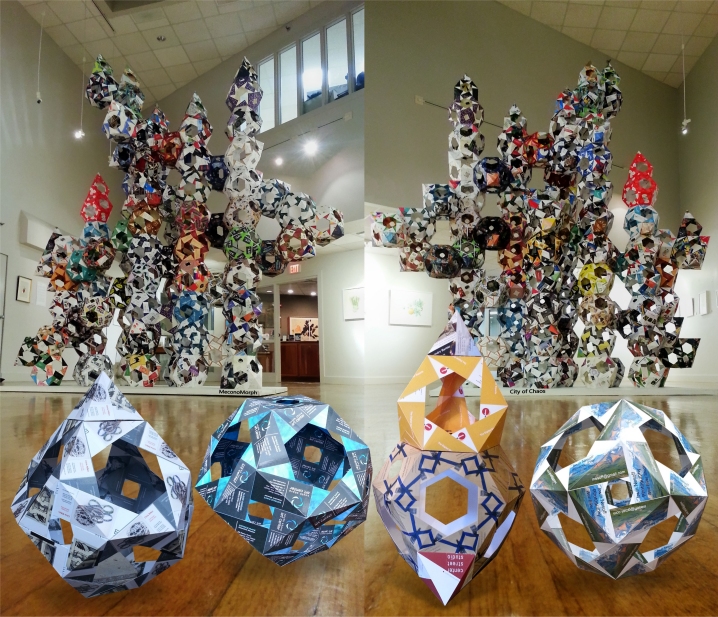
MeconoMorph has no single definitive physical embodiment. It manifests through historically situated incarnations composed of Mecons and related constructions. Its continuity cannot be reduced to the preservation of one shape or one inventory of parts. A module can retain its material history while changing its place, and an incarnation can change its constituents without that substitution alone deciding its identity. The identity of the participatory initiative, the identity of a particular incarnation, and the identity of an individual module operate at different levels. Structural interchangeability permits compatible substitution while material histories remain particular.
The identity of the initiative, the identity of a particular incarnation, and the identity of an individual module operate at different levels. Structural interchangeability permits substitution in compatible assemblies; it does not make material histories identical or establish that every reconstruction continues the same incarnation.
A Work Without a Definitive Body
MeconoMorph is encountered through bodies that do not exhaust it. A configuration can be present, altered, dismantled, or absent while the initiative remains intelligible through its construction practice, surviving modules, and history of manifestations. No one assembly supplies a final portrait of what MeconoMorph is. The object visible at a particular moment is an incarnation of the initiative rather than its complete physical identity.
To say that MeconoMorph has no definitive embodiment does not make its actual embodiments unreal. Their materials, arrangements, sites, and histories are concrete. The distinction concerns the level at which identity is claimed. A photograph can establish what an incarnation looked like at one moment; it cannot, by itself, establish the whole identity of an initiative whose manifestations have changed.
The familiar distinction between a repeatable structure and its particular instances is useful here, but insufficient on its own. MeconoMorph is also a historical undertaking. Its modules are made from particular cards, its incarnations develop in particular circumstances, and its material pool carries previous participation forward. Treating it only as an abstract geometric pattern would discard the histories through which it becomes a work.
The Mecon as an Atomic Unit
A Mecon is a complete construction made from folded and internally joined business cards. It is atomic at the scale of the larger assembly: the unit entering into that assembly is the Mecon, not a loose inventory of independently movable cards. This operative boundary distinguishes the making of a module from the arrangement of modules into an incarnation.
The distinction also separates two kinds of joining. Internal joining establishes the coherence of the unit. Relations between units establish a larger configuration that can admit alteration and replacement. The permanence of a module's internal construction and the variability of an incarnation's composition are therefore compatible. Stability at one level enables change at another.
Interchangeability and Material Difference
Mecons are interchangeable within compatible assemblies. That statement concerns what another unit can do in a position, not whether the two units are indistinguishable. Replacement may preserve a relation of support or an arrangement of connections while introducing different printed surfaces, colours, wear, and fabrication histories.
Two modules can consequently be equivalent for an operation without being the same material object. A card's former professional identity can remain visible after its ordinary mode of service has been interrupted. That printing belongs to the particular material of a module even when it has no bearing on the module's structural compatibility.
In the first Luchies interview, Genel describes fabrication as manual work that repeatedly draws his attention back to the content of the cards. Their differences create patterns he can influence without fully controlling. Material particularity is consequently active during making, not merely an incidental surface discovered after a geometrically identical unit has been completed.
At the level of an incarnation, replacement raises a separate question. A structure may retain its recognizable form after several modules have changed. Conversely, a structure may change its form while continuing as a named incarnation. Appearance and inventory are evidence about continuity, but neither supplies a universal identity rule.
Geometry and the Presence of Voids
Normal Mecons are truncated octahedrons. The ideal truncated octahedron has eight hexagonal faces and six square faces and can tessellate three-dimensional space without gaps. This property belongs to the geometric form; a constructed incarnation is a material arrangement that selects and realizes particular relations available within it.
Mini-Mecons introduce a distinct geometry. They are truncated tetrahedrons, not simply smaller versions of the truncated octahedron. Genel describes their combination with normal Mecons as a different lattice containing hollow spaces. The difference concerns how units relate in three dimensions, rather than a change of scale alone.
Other business-card constructions extend this material vocabulary. Genel has made truncated cubes, square-based pyramids, and tetrahedrons, or three-dimensional simplices. He describes these forms in relation to lattice voids, while noting that the pyramidal constructions currently also serve as visual additions without necessarily filling those voids. Their spatial role and their visible role need not coincide.
The void is thus not simply an unfinished piece of the sculpture. It can be a consequence of the relations selected between modules. Adding a construction can occupy a space, emphasize a direction, or change the visible articulation of an incarnation. Those operations should not be collapsed into one requirement to complete a solid mass.
Deutilization and Continuing Capacity
The business card arrives with an assigned service. Its dimensions, printing, and handling are ordinarily organized around professional identification and exchange. That service supplies a familiar account of what the object is for. Deutilization interrupts the authority of this account without requiring the material to lose every capacity.
This is not a passage from useful matter to matter with no effects. A deutilized card can still support, connect, display printing, and participate in a configuration. The relevant interruption concerns its assigned service, rather than the abolition of physical capacity. A module's structural activity does not, by itself, restore the card's original appointment.
The difference is important because capacity and prescription are not interchangeable concepts. Capacity describes what material can do under particular relations. Prescription narrows what it is expected to do and how its success is judged. MeconoMorph makes other capacities legible by releasing the card from the dominance of its conventional service.
Incarnations and Shared Material Histories
The archive's City of Chaos record gives a concrete account of material continuity. Its 2017 assembly incorporated modules previously used in Sand Clock and intervening configurations. Its form emerged during assembly rather than following a predetermined final image. This is a documented procedure of one incarnation, not a rule that should be imposed on every MeconoMorph construction.
The survival of modules across those arrangements establishes a shared material history. It does not establish that the later incarnation is simply the earlier one under another name. A constituent can continue while the body in which it participated has ended. Material persistence and formal descent are different relations.
Raptor provides another distinction between an incarnation and the activity passing through it. Its Seed role involved collecting card material that could support module production beyond its own body. Contributions made at one visible assembly did not have to become additions to that same assembly. The collection site, the resulting units, and their eventual positions could be separated.
Public Presence and Material Duration
An incarnation also acquires a history through the conditions of its public presence. At TEDxSomerville REINVENT on 27 September 2015, a winged MeconoMorph occupied the stage at Tufts University's Cohen Auditorium. Patrick McDonagh's report in The Somerville Times identifies the business-card construction as featured on stage; Genel recalls that it remained there throughout the event. Its presence was sustained within the setting of the presentations, rather than confined to a separate display encountered in passing.
Raptor's duration makes a different material point. Cathren Housley's November 2019 Motif article dates its arrival at the Providence Visitor Center in the Convention Center to 23 January 2019. New York Weekly still identifies Raptor at that location in June 2024. The archive and Genel's account place its assembled life across 2019-2025, approximately six years. This duration matters because the work's paper construction was capable of a prolonged indoor existence.
Raptor's survival demonstrates durability at the level of this assembled incarnation. It does not establish that every original card remained unchanged or that no module was repaired or replaced. Those questions require a component history. Yet the distinction strengthens rather than weakens the conceptual account: a replaceable modular structure can sustain a public life without requiring every constituent to be treated as permanent.
Visual Encounter and Conceptual Depth
The conceptual account of MeconoMorph does not require visual dullness. Its relationships become perceptible through colour, scale, repetition, exposed interiors, and the differences between printed cards. These qualities are part of the encounter through which the viewer discovers the construction, rather than an ornament added to make a separate theory more approachable.
Juried reception gives this relation a concrete public context. MeconoMorph received First Place in the Sculpture/Sculptural 3D/Ceramics category at the Vero Beach Art Club's 2025 Art by the Sea exhibition. Tree of Life received Best of Show at the Alliance for the Arts' 39th Annual All Florida Juried Exhibition in Fort Myers that March. The first distinction is a category award; the second is an exhibition-wide award.
Tom Hall's WGCU report explicitly states that All Florida jurors Tim Yaeger and Barbara Hill selected from digital images without artists' names and did not learn the selected artists' identities until the opening reception. Genel also describes the Art by the Sea judging as anonymous. The documented All Florida procedure makes visual reception particularly relevant: recognition was not dependent on the artist's identity being supplied with the submitted images.
These awards do not prove the essay's ontology, nor do they provide a universal measure of beauty. They do establish that particular incarnations were recognized within juried visual assessment. Their theoretical relevance is the compatibility of conceptual depth with a compelling visible body. A work can sustain questions about identity and function while offering an immediate experience that rewards attention.
Participation as Material Activity
MeconoMorph is a participatory initiative. Contributions supply material from which modules can be made, and fabrication itself has occurred beyond Genel's own hands. His wife has constructed Mecons; his daughter and her husband have assembled several that remain with them in California. These examples establish participation in making, alongside participation through the provision of cards.
The significance of these acts is not exhausted by the number of people involved. They show that the construction practice can be enacted by someone other than its initiator. A module made by another participant can have the relevant structural form while acquiring a distinct fabrication history.
Continuity Across Different Levels
Three continuities must therefore be kept distinct. A module continues through its material existence and history. An incarnation continues through the history of a particular manifestation, which can include changes in its composition. The initiative continues through the relations connecting construction practice, participation, surviving material, and recorded incarnations.
None of these continuities requires all the others to remain unchanged. A module can survive the dismantling of an incarnation. A new module can enter a continuing assembly. An incarnation can end without exhausting the initiative. These possibilities do not dissolve identity; they locate it at the level appropriate to the relation being described.
MeconoMorph's theoretical force lies in this articulation of change. The work is neither secured by one permanent body nor reduced to geometry detached from material history. Its configurations can possess visual force and sustained material duration while their constituents remain structurally available for further relations. What continues is made intelligible through the distinctions between a body, its units, and the initiative of which it is an incarnation.
Read the Full Essay
These passages are excerpts from MeconoMorph and the Identity of Changing Structures (PDF). The complete seven-page essay includes references and source notes.
References and Further Reading
- Michael Luchies: Business Cards Morphed Into Art; Boosting a Business with Art; MeconoMorph; Interview with Viktor Genel.
- Cathren Housley, MeconoMorph Seed Grows in Providence, Motif, 2019.
- Patrick McDonagh, TEDxSomerville Reinvent, The Somerville Times, 2015.
- Tom Hall, Alliance for the Arts 39th All Florida Exhibition, WGCU, 2025.
- Vero Beach Art Club, 2025 Art by the Sea Winners.
- Eric W. Weisstein, Truncated Octahedron, MathWorld.
- NY Weekly Contributor, The MeconoMorph Movement, New York Weekly, 2024: dated location record.
- Joan B. Reid, Genel’s MeconoMorph sculptures bridge art, sustainability, Vero News, 2025.
- Linda Wetzel, Types and Tokens, Stanford Encyclopedia of Philosophy.