Deutilization and the Duchamp Legacy
Deutilization and the readymade describe overlapping aspects of an artistic event. Duchamp’s Bicycle Wheel separates rotation from transport through material assembly; Fountain displaces sanitary service through reorientation and presentation. Both provide precedents for interrupting prescribed use. Deutilization makes that interruption the explicit subject of sustained material inquiry, examining capacities that service had subordinated. New structural roles, interpretation, and museum preservation remain open to scrutiny because release from one assignment can lead to another. The distinction concerns analytical emphasis and method, while acknowledging Duchamp’s historical contribution.
The readymade emphasizes selection, authorship, presentation, and reception as art. Deutilization emphasizes the authority of prescribed service and the capacities made available when that authority is interrupted. The two can coexist within one work; physical alteration is neither exclusive to Deutilization nor a requirement for every interruption.
The operation within the precedent
Marcel Duchamp is one of my inspirational figures. I understand Bicycle Wheel and Fountain as works in which an object’s prescribed service is interrupted, making another encounter with its material form possible. This is the operation I call Deutilization. The term belongs to my own practice; the operation has important precedents more than a century earlier. A serious account of the connection must acknowledge those precedents without attributing my vocabulary or a complete version of my philosophy to Duchamp.
My proposition is that Deutilization and the readymade describe overlapping aspects of an artistic event. The readymade directs attention to selection, authorship, presentation, and the conditions under which an object is received as art. Deutilization directs attention to the authority of prescribed use and what happens when that authority is interrupted. An object can participate in both. Recognizing that overlap makes the Duchamp connection more precise than treating my practice as the opposite of his.
What Deutilization interrupts
Deutilization is a deliberate interruption of an object’s prescribed service that opens inquiry into capacities subordinated to that service. A manufactured thing arrives with more than a shape. Its name, anticipated handling, position within a system, and criteria of success organize attention before anyone uses it. A traffic cone directs movement. A business card identifies a person within professional exchange. These assignments are learned and maintained, yet they can appear inseparable from the objects themselves.
Physical incapacity is one possible means of interruption. Reorientation, detachment, aggregation, or withholding an object from its normal system can also suspend its service. Conversely, a broken thing is not necessarily deutilized: accidental failure may leave its owner entirely committed to repair and restored use. The relevant change concerns how the object is approached and what its practical assignment is permitted to govern.
Bicycle Wheel and retained motion
For Deutilization, the decisive feature is the separation of capacity from service. The wheel can still turn. Rotation, which contributed to transport in a bicycle, remains available when transport has been removed. The stool continues to support weight, but the mounting obstructs its familiar role as a seat. These components retain physical abilities while their combination interrupts the tasks by which they were ordinarily understood.
The work therefore makes a useful distinction visible: releasing a thing from prescribed service does not require eliminating its operation. The wheel’s motion becomes perceptible under different conditions. Its bearing, circular organization, and responsiveness can be encountered without measuring their contribution to getting a rider somewhere. The stool’s supporting structure enters a new relation with that motion. This is my reading of the assembly, rather than a claim that Duchamp articulated Deutilization as a doctrine.
Bicycle Wheel also corrects an overly simple contrast between Duchamp’s designation and my material intervention. His assembly required an alteration and a joining of components. A description limited to an artist pointing at an untouched commodity misses the material event in this particular work. The difference between our practices cannot rest on the proposition that Duchamp never made physical changes.
Fountain and useful significance
The contemporary defense already gives functional displacement a prominent place. In The Blind Man, no. 2, the editorial on the Richard Mutt case argued that the object’s “useful significance disappeared” under its new title and point of view, producing a “new thought for that object.” The Philadelphia Museum of Art reproduces this passage in its account of the controversy. The disappearance of useful significance is therefore present in the work’s early discourse, rather than an issue that only a later theory discovered.
I read the reoriented object as an effectively deutilized urinal. Its ceramic body and manufactured contour survive, while its installation for sanitary service is withheld. That wording names the displaced assignment without making the old category the final identity of the thing. It asks what can be encountered when the demand that this form receive urine ceases to determine its treatment.
This reading does not establish that Duchamp intended to reveal an intrinsic essence, nor does it prove that he considered deutilization more important than institutional provocation. Those are separate questions. Fountain supports an account of interrupted service; its documented history also supports an account of selection, naming, and contested artistic admission. A comprehensive interpretation must allow these events to coexist.
MeconoMorph and HedgeCone
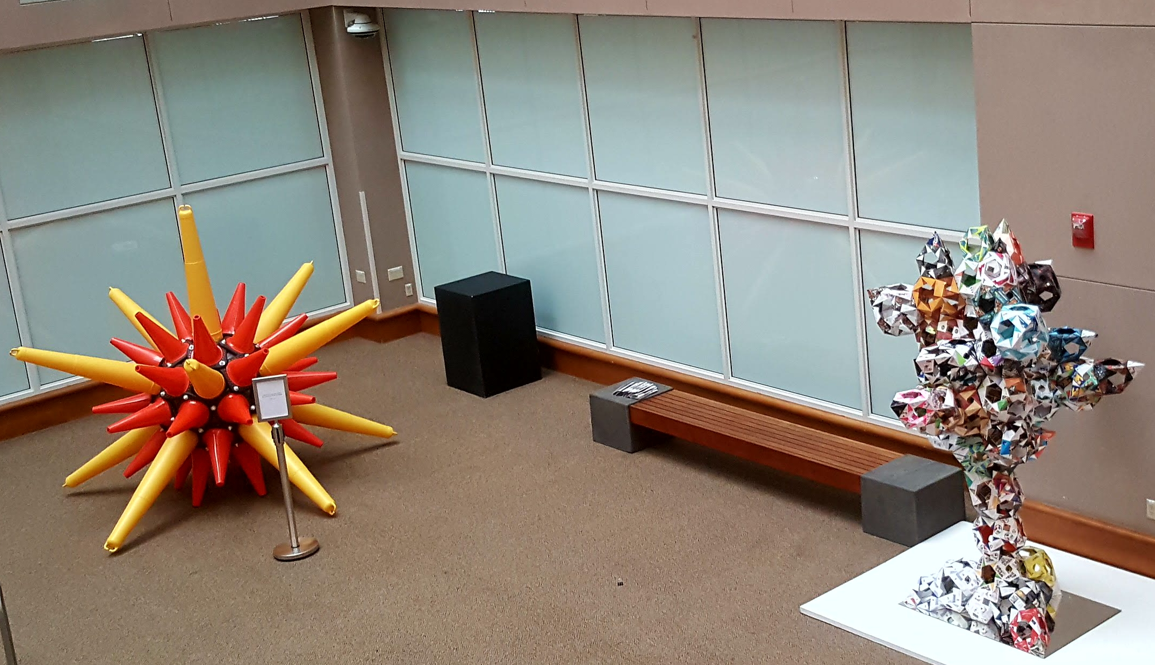
In MeconoMorph, I fold business cards into repeatable units and join them into structures. Professional identification recedes as the governing task, while proportion and material behavior become active within an assembly. A card can retain printing, a name, or an association with its contributor. Deutilization does not depend on erasing those traces. It depends on their no longer exhausting the card’s available relations.
The resulting structures introduce a real tension: the cards now perform structural work. They are not absolutely useless. Supporting, joining, and maintaining a configuration involve purpose and material demands. If Deutilization meant the end of all function, this example would contradict it. Under the definition developed here, structural activity is compatible with interruption of prescribed service, while remaining available for critical examination as a new assignment.
HedgeCone offers a different material case. Its supplied account describes an assembly of new traffic cones, toilet-seat fasteners, and an exercise ball, first developed for a Boston installation in 2013. Traffic control ceases to organize the cones’ arrangement. Their form and mounting possibilities instead enter a geometric construction. The fasteners retain a joining capacity while being removed from their assigned fixture. This again separates an available physical operation from its prescribed service.
Transitivity and the museum
David Joselit’s published essay Painting Beside Itself provides a useful vocabulary for passage between contexts. He develops transitivity through the movement and translation of artworks within networks, including the relation between a painting’s internal events and its surrounding social conditions. His account also questions the idea that circulation can be permanently arrested by collection, display, or storage. This is a situated argument about painting, not a ready-made definition of Deutilization.
The connection I propose is that Deutilization intervenes within passage. It makes a particular transition examinable: an object’s assigned service loses its governing position, and other relations become available. Transitivity describes a broader condition of movement and translation. Deutilization names a deliberate operation affecting one authority within that condition. This relationship leaves room for both concepts instead of making one a substitute for the other.
The museum tests the claim of liberation. Release from practical service can be followed by an obligation to remain intact, retain an authorized arrangement, or stand as an example of an established category. These obligations have reasons, including preservation and historical accountability. Nevertheless, they organize what people may do with a thing. Artistic status does not automatically mean freedom from prescription.
A lineage with an open question
The contribution I seek is an explicit vocabulary for the authority of prescribed service and a sustained material practice that tests its interruption. The distinction from the readymade concerns analytical emphasis and the development of a method. It cannot depend on claiming that removal of function was absent from Duchamp, that he merely designated untouched objects, or that all later purpose cancels release.
The remaining question is whether a new relation lets capacities become perceptible or merely installs another exhaustive task. That question applies equally to the artist’s construction, the viewer’s interpretation, and the institution’s preservation. Deutilization remains consequential when it keeps this relation open to scrutiny. Its connection to Duchamp gives that inquiry historical depth and a demanding precedent against which to test its own claims.
Read the Full Essay
These passages are excerpts from Deutilization and the Duchamp Legacy (PDF). The complete essay develops the relation between designation and interpretation, the claim of material essence, and the boundary with Preutilization, with references and further reading.
References and Further Reading
- The Museum of Modern Art. Marcel Duchamp’s Readymades: Celebrating the Centennial.
- Centre Pompidou. Roue de bicyclette.
- Philadelphia Museum of Art. Marcel Duchamp and the Fountain Scandal.
- Arteanity. Before and After Assignment.