Before and After Assignment
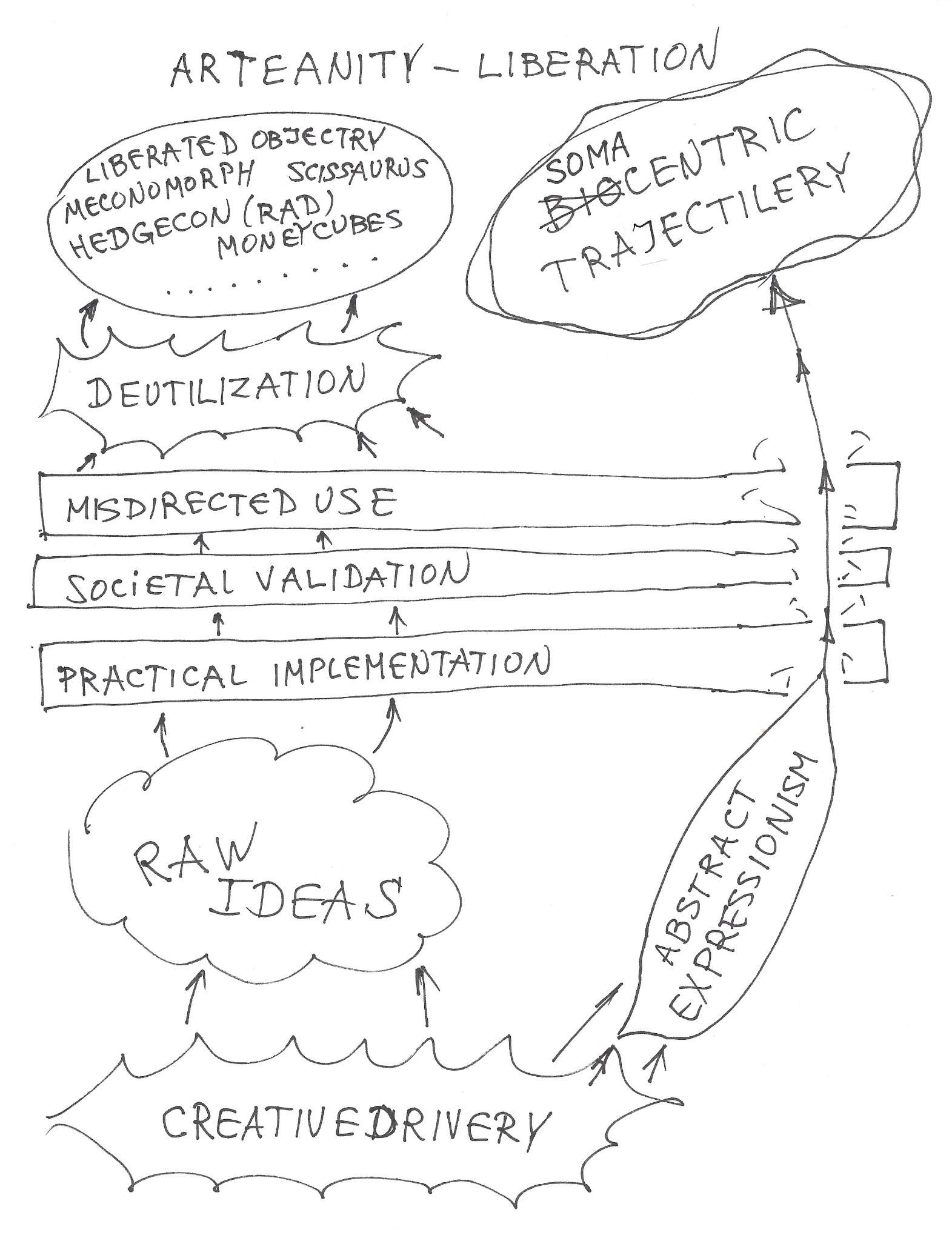
Both methods intervene in assignment. Deutilization acts after an object has acquired a prescribed function or identity and releases it from that prescription. Somacentric Trajectilery acts before the emerging work has been assigned an image, subject, desired visual trait, or interpretive destination. This prior suspension is named Preutilization. It is a methodology within Somacentric Trajectilery, not a separate Branch: conditions may govern the event, but no image is appointed in advance for the trajectile to fulfill.
Deutilization releases an existing object after assigned utility has become authoritative. Preutilization prevents a prospective image, use, or trait from governing a Somacentric event before the artifact exists. Both retain intention, but at different moments and with different jurisdictions.
Assignment Precedes Use
An object is often captured before it is used. A door has already been assigned to opening and closing an architectural passage before anyone installs it. A furniture panel, cabinet, sheet of metal, or business card arrives under a name that carries instructions about what it is for, how it should be handled, and what counts as its successful performance. Manufacture gives matter a form, but assignment gives that form a social destiny.
The assignment can become so persuasive that it appears to belong to the object itself. We stop seeing a plane of wood under tension and see only a door. We stop seeing a folded structural module and see only a token of professional exchange. Utility becomes the dominant reading, and every other capacity of the object recedes behind it.
Assignment is not confined to useful things. It also enters art before the first physical event. A sheet may be assigned to carry a picture. A movement may be assigned to produce elegance, violence, balance, expression, or a recognizable style. The hand then works on behalf of an image that has already begun to exist in thought. Even spontaneity can serve such an appointment. An action may be fast and unrehearsed while still trying to look spontaneous.
Deutilization and Somacentric Trajectilery meet at this threshold. They approach it from opposite temporal directions.
Deutilization Acts After Assignment
Deutilization begins with an object whose use has already been made legible. It does not deny the object's manufactured history. Without that history, there would be nothing to deutilize. The protocol works upon the bond between a form and its prescribed function.
This is why Deutilization is neither ordinary reuse nor the decoration of a useful object. Reuse transfers an object from one function to another: a door becomes a table, a cabinet becomes a planter, a bottle becomes a lamp. The original assignment is replaced, but the demand for service remains. Decoration leaves the assignment intact and adds an aesthetic surface to it. In both cases the object continues to justify itself through a projected use.
Deutilization interrupts that demand. The door need not open, support, display, or symbolize anything else. Its planes, edges, layers, joints, coatings, and internal stresses can enter a new material relation without being recruited into another practical identity. The action occurs after assignment and removes its authority.
This operation is necessarily conscious. The assigned use must first be recognized. A method must then prevent it from quietly returning under another name. That vigilance explains the deliberate character of Deutilization. Its slowness is not hesitation. It comes from working through an existing structure of expectation.
Historical works can approach this operation without being retroactively absorbed into it. Bicycle Wheel by Marcel Duchamp interrupts the ordinary service of both wheel and stool, while the established category of the readymade emphasizes selection and designation. The work can therefore be read as a powerful precedent for release from assigned use. Deutilization, however, names an explicit and sustained protocol whose recurring subject is the authority of utility itself. Historical adjacency does not erase methodological difference.
Preutilization Acts Before Assignment
Somacentric Trajectilery encounters the same problem earlier. At the instant of launch, there is not yet an artifact from which an assigned image can be removed. The decisive act is therefore preventive.
Preutilization names the deliberate suspension of prospective assignment before and during the formation of a Somacentric Trajectile. The term does not mean preparation for later use, as it may in ordinary technical language. Within Arteanity, it identifies an intervention before intended use has captured the event. No subject, composition, expressive effect, desirable accident, or visual trait is appointed for the trajectile to deliver.
The prefix pre identifies the location of the method. Deutilization releases an existing thing after assignment. Preutilization protects an emerging thing before assignment can become its cause.
This does not require an empty mind. The body arrives with memory. The hand carries anatomy, age, fatigue, acquired skill, resistance, impulse, and decades of structural attention. Materials also arrive with properties and conventional uses. Pastel is made to mark; paper is made to receive marks; the PVC coupling used as an indirect tool was made from tubing initially manufactured for plumbing. Preutilization does not pretend that these histories vanish. It prevents them from dictating what the event must become.
Nor does Preutilization prohibit rules. A record may begin with a chosen substrate, a limited group of colors, simultaneous use of two hands, an indirect tool, or a condition such as no intersections or cross immediately. These are launch conditions. They alter the field in which the body and materials meet, but they do not specify the image that must result. A rule can govern conduct without assigning appearance. Nameless Number Twenty One prohibited chromatic intersections; Nameless Number Twenty Two required immediate crossing. Their opposed duties changed what an encounter permitted without designing either finished form.
The distinction is exact. Composition tells a mark where it should go in order to complete an anticipated whole. A Somacentric rule tells the body what condition it must encounter and leaves the whole unknown. The first trajectory changes the conditions for the next one. Pigment accumulates, the substrate pushes back, a stick fractures, a tool releases its remnants, and the event proceeds through consequences that could not have been pictured beforehand.
Preutilization therefore differs from improvisation as that word is commonly used. Improvisation often varies a known language in real time. It can still aim toward coherence, resolution, expression, or stylistic success. Preutilization suspends the authority of those prospective judgments at the point of action. Whatever coherence appears must arise from the event rather than supervise it. Its relation to automatism and intention is examined in Before Composition: Preutilization, Automatism, and Intention.
The Trajectile Cannot Fail
The governing rule of Somacentric Trajectilery follows directly: the trajectile never fails.
This is not a declaration that every material behaves as expected. Pastel can break. Pigment can detach. Paper can tear, buckle, resist, or receive less material than the force attempts to deposit. A tool can redirect pressure or lose the fragments it carries. These are real material events and may include failures of medium, substrate, or instrument.
The trajectile itself cannot fail because failure would require a prior image against which the result could be judged deficient. Under Preutilization, no such image has been assigned. Penetration, abrupt retreat, curved evasion, interruption, breakage, and continuation are not deviations from a design. They are the record of force negotiating matter.
This is also why correction would be conceptually destructive. To correct the trajectile would be to appoint a visual use after the fact and then subordinate the existing event to it. The correction would claim that the mark was supposed to become something other than what occurred. Preutilization blocks that retroactive command as firmly as it blocks advance composition. In Nameless Number Nineteen, the compound PVC holder lost two pastel fragments during passage; the changed apparatus continued without retrieval, reconstruction, or restart.
Interpretation Comes After the Event
An unassigned event does not remain uninterpreted forever. The distinction lies in sequence and authority.
After a Somacentric Trajectile exists, it can be photographed, rotated, compared, entered into a corpus, described through material evidence, and examined in Critical Commentary. Relationships can be discovered among crossings, overlays, voids, fractures, tools, and earlier records. None of this violates Preutilization because the analysis did not prescribe the event it studies.
The archive is therefore posterior to the act. Its task is to preserve what happened and make later understanding possible. It may identify a threshold, a recurrence, or a material consequence that was invisible at the moment of formation. It cannot honestly insert that later knowledge into the event as an original intention.
This separation is especially important when artificial intelligence participates in the archive. AI can assist with comparison, language, and the reconstruction of relationships after the physical record exists. It does not become the author of the trajectory. The body, tool, medium, substrate, velocity, and collision produced the evidence to which the commentary must remain answerable.
Naming also occurs after the event. Nameless does not claim that the artifact lacks an archive identity. Numbering, dating, corpus placement, and material description are necessary forms of custody. The term refuses a title that would tell the viewer what the artifact depicts or what interpretive function it should perform. The name records the resistance to naming as capture.
One Threshold and Two Directions
Earlier accounts described Deutilization as the slow, intellectual route through imposed function and Somacentric Trajectilery as the rapid bodily route that bypasses it. That distinction remains true, but it does not yet explain why the two methods belong to the same lifelong inquiry.
Assignment supplies the missing connection.
Deutilization begins with a thing already claimed by use and works backward. Preutilization begins before the work has acquired a projected use and holds that threshold open. One removes an assignment that has hardened around an object. The other withholds assignment while an artifact comes into existence.
Their tempos differ because their positions differ. Deutilization must encounter a completed social reading. It proceeds through recognition, refusal, and material reconfiguration. Somacentric Trajectilery must outrun the formation of a controlling image. It proceeds at the speed of bodily action. Consciousness is not absent from either method; it operates at different times. In Deutilization, consciousness performs the release. In Somacentric Trajectilery, consciousness establishes the conditions and then refrains from prescribing the result.
The two operations also protect different things. Deutilization releases the object from compulsory service. Preutilization releases the event from compulsory fulfillment. Together they define a broader Arteanity principle: form should not be exhausted by the assignment placed upon it.
Before and After
The relationship between Deutilization and Somacentric Trajectilery is not a resemblance discovered after two unrelated bodies of work appeared. It is a shared operation exposed at two points in time.
After assignment, an existing object can be released from what it has been told to do. Before assignment, an emerging artifact can be protected from being told what it must become. Deutilization and Preutilization stand on opposite sides of that boundary.
Somacentric Trajectilery gives Preutilization physical form. The methodology clears the event of an assigned destination; the body launches; matter answers; the trajectile continues. Only afterward does the archive begin its work.
References and Further Reading
The following sources establish the historical and theoretical vocabulary used in this essay. Arteanity-specific claims remain grounded in the linked archive and artifact records.
- Tate. “Readymade.” Art Terms.
- The Museum of Modern Art. “Marcel Duchamp. Bicycle Wheel. 1951 (third version, after lost original of 1913).” Collection record.
- The Museum of Modern Art. “Automatism.” Art Terms.
- The Museum of Modern Art. “André Masson. Automatic Drawing. (1924).” Collection record.
- Anscomb, Claire. “Creative Agency as Executive Agency: Grounding the Artistic Significance of Automatic Images.” The Journal of Aesthetics and Art Criticism 79, no. 4 (2021): 415-427.
- Butler, Cornelia H., and Catherine de Zegher. On Line: Drawing Through the Twentieth Century. Exhibition and catalogue. The Museum of Modern Art, 2010.