Material Resistance and the Physical Trace
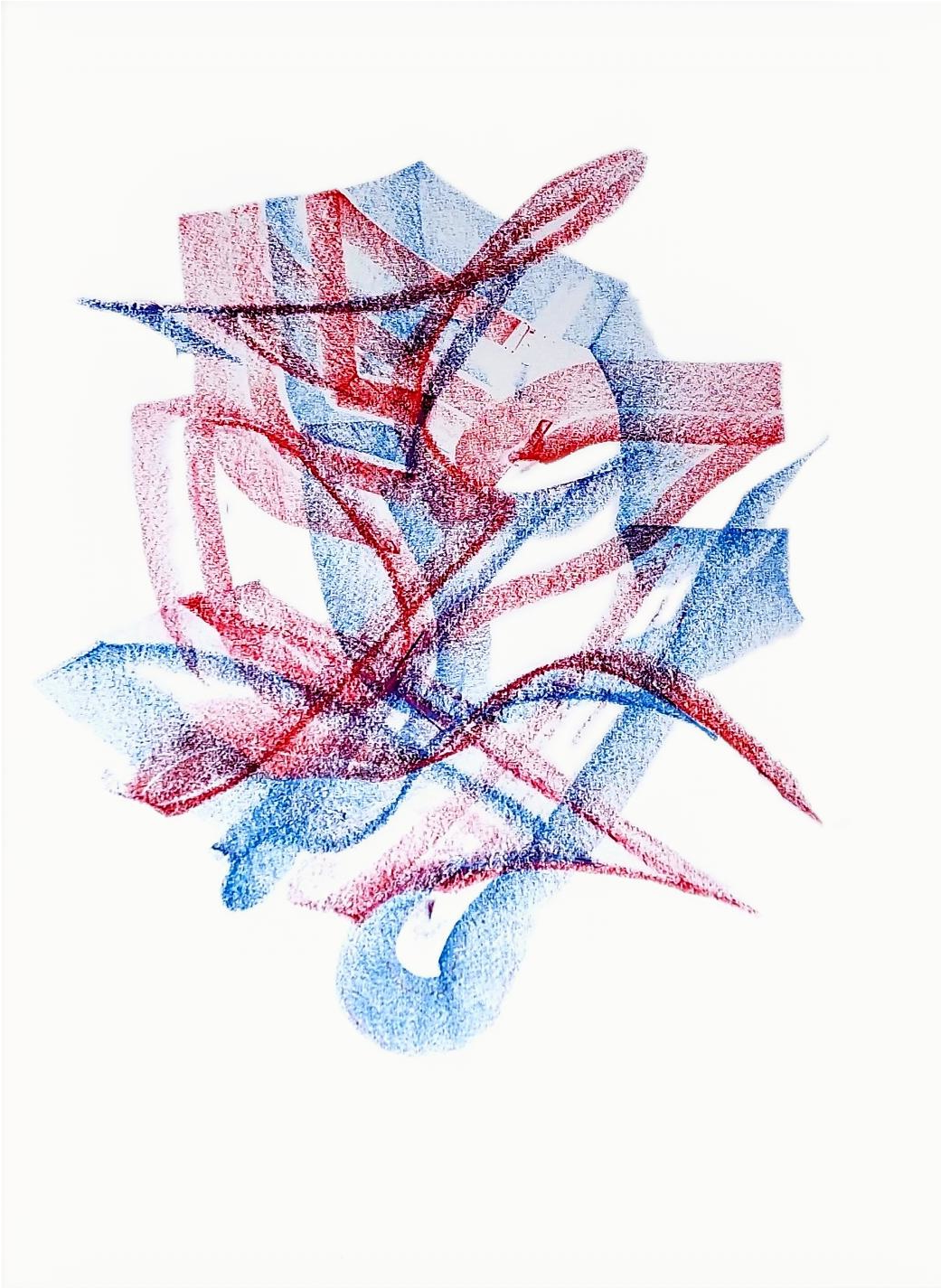
Material resistance can help determine a physical trace causally without possessing intention or consciousness. Friction, substrate texture, medium consistency, prior deposits, and changes in the tool alter what bodily action can materially become: what is deposited, interrupted, redirected, or left absent. In Somacentric Trajectilery, these consequences remain within an event whose retrospective correction is restricted. Nameless Number Nineteen preserves continuation through lost pastel fragments; Nameless Number Seventeen records coupled sticks meeting an abrasive support. The trace therefore belongs neither to bodily intention alone nor to matter treated as an independent author. It belongs to a documented encounter.
Causal participation is not the same as intentional agency. Material properties help determine the trace without becoming conscious authors of it.
Materiality Beyond the Choice of Medium
To identify a drawing as pastel on paper is necessary, but it does not yet explain the event that produced it. The material relation includes the character of the stick, the surface it meets, the angle of contact, the pressure applied, and the succession of earlier deposits encountered along the way.
These conditions are not a transparent channel between intention and image. They influence the width, density, interruption, and direction of the mark. Resistance may retard movement, redistribute contact, or cause a stick to break. A gesture that meets resistance becomes a different material event from the movement considered in isolation.
The language of material agency is useful here only if it remains precise. Matter need not possess intention or consciousness to participate causally. Its properties help determine what occurs, including consequences that the artist did not specify.
A Historical Intersection with Process Art and Process-Based Drawing
Process art provides an established context for treating material behavior as constitutive rather than incidental. MoMA's discussion of Robert Morris's Untitled of 1969 describes felt subjected to procedures such as cutting and hanging, with gravity and the material's properties helping determine its configuration. Formal relations remained present even when an enduring form was not prescribed in advance.
Within contemporary drawing, process-based practices similarly treat medium, support, duration, and handling as constitutive conditions rather than passive carriers. This vocabulary clarifies the comparison without assigning intention or consciousness to matter.
Somacentric Trajectilery shares this attention to what materials do, but the comparison is not an assertion of equivalence. Its focus is the bodily-material trajectory and the trace retained through contact. Material contingency operates within particular conditions of action, including restrictions on correction and on the authority of a developing image.
The question is therefore not whether process matters. It is how a specific process distributes determination among the moving body, the instrument, the medium, and the receiving surface. The selective record produced by this system is examined in The Body as Recording Instrument.
Friction, Deposition, and the Unmarked Interval
In its account of dry pastel, The Metropolitan Museum of Art explains the role of paper texture in retaining particles. Broad side contact can reveal the support's texture, while tip contact and greater pressure can produce more concentrated marks. These are material differences, not simply alternative visual effects.
Soft pastel and oil pastel should not be treated as interchangeable under one generalized story of resistance. Nor does a rough-looking passage establish its own cause. A porous deposit may result from several interacting conditions; a photograph alone cannot isolate their relative contributions.
In Somacentric work, an unmarked interval can nevertheless be as important as a deposited band. It may register lost contact, a restriction against crossing, or the surface's incomplete reception of the medium. Absence is not automatically a gap awaiting repair. Its interpretation depends on the recorded event.
Nineteen: Continuation Through Material Loss
Nameless Number Nineteen was made with a provisional PVC holder carrying previously broken red and blue soft-pastel remnants. Several pieces detached during the event. They were not retrieved, replaced, or restored to recover the initial contact arrangement.
The changing apparatus matters. The record associates broader compound deposits with the earlier configuration and more exposed red and blue trajectories with its depletion. The event continued with fewer remaining contacts; it did not pause to reconstitute an ideal tool.
This is more specific than accepting an accident after judging its aesthetic usefulness. Material loss altered what the ongoing action could deposit before interpretation had settled its significance. The archive subsequently names this continuation Trajectile Persistence; that retrospective term should not be mistaken for evidence that a formal protocol bearing the name had been announced beforehand.
The artifact retains the consequences of a tool that did not remain identical to itself throughout the action.
Seventeen: Coupling Meets an Abrasive Surface
Nameless Number Seventeen presents another material relation. A flexible, cut-open PVC sleeve coupled red and blue soft-pastel sticks, used with both hands on UArt 400. Coupling joined the contacts without converting them into a rigidly controlled mechanical path.
The artifact record describes skips, catches, porous fields, interrupted bands, and compressed nodes. Differences in angle and pressure met the abrasive surface through the coupled instrument. The resulting red-blue field cannot be adequately explained as one intention reproduced twice.
The comparison with Nineteen is instructive. One record emphasizes the interaction of coupling and surface; the other emphasizes a changing set of contacts through material loss. Neither licenses a general claim that every irregularity is a failure or that all failures have artistic significance. Each requires its own causal account.
Resistance as a Condition of the Trajectile
A physical trace may register resistance even in a carefully planned drawing. Resistance alone therefore does not define Somacentric Trajectilery. The disciplinary distinction also concerns what the artist is permitted to do with the consequences: whether an interruption is corrected toward a governing image, or whether the event continues with its altered conditions.
This is why directness cannot mean the absence of mediation. A pastel, a PVC coupling, and a textured sheet mediate contact while remaining materially active within the same occurrence. Their participation is not an impurity to be subtracted from the body's contribution.
Within Arteanity, the Trajectile makes this distributed determination available for examination. The finished work is not merely the record of what a body wanted to do. It retains what happened when that body acted through an instrument upon a material surface that could resist, receive, interrupt, and change the action.
References and Further Reading
The following sources establish the historical and theoretical vocabulary used in this essay. Arteanity-specific claims remain grounded in the linked archive and artifact records.
- The Museum of Modern Art. “Robert Morris. Untitled. 1969.” Collection record and publication excerpt.
- The Metropolitan Museum of Art. “Pastel.” Materials and Techniques, 2020.
- Di Paolo, Ezequiel A., Diego Lawler, and Andrés Pablo Vaccari. “Toward an Enactive Conception of Productive Practices: Beyond Material Agency.” Philosophy & Technology 36, article 31 (2023).