The Body as Recording Instrument: Involuntary Drawing and the Graphic Trace
The body functions as a recording instrument when its movement is translated through contact, medium, support, or another apparatus into a graphic trace. This does not make the body neutral, unconscious, or free of intention. In Somacentric Trajectilery, “involuntary” describes only those aspects of the emerging trajectory that are not individually composed as pictorial decisions. The artifact selectively retains pressure, friction, interruption, accumulation, and material sequence, while documentation supplies the conditions the surface cannot disclose alone. The Somacentric distinction lies in joining bodily inscription to protocols that restrict compositional control and preserve the irreversible consequences of the event.
Calling the body a recording instrument does not make its trace a neutral or complete transcript. Body, instrument, medium, support, and documentation determine what is retained; Somacentric protocol specifies how compositional authority is restricted within that selective recording system.
From Depiction to Bodily Registration
To call the body a recording instrument is to shift attention from what a drawing depicts to how movement becomes materially registered. The phrase does not mean that the body is a neutral machine or that a drawing contains a complete transcript of bodily experience. It identifies a relation: movement passes through an implement or point of contact, encounters a receiving medium, and leaves a graphic consequence.
This relation belongs to an expanded history of drawing. MoMA's On Line describes line not only as a mark made on paper but as the path of a moving point or a human body in motion. Drawing can therefore occur across space and time before it becomes a stable object. When a support retains part of that passage, the finished mark can be approached as a record of movement rather than merely as an image of movement.
That bridge is important for Somacentric Trajectilery. Its artifacts are not illustrations of bodily energy added after an action has been conceived. They are material residues of trajectories produced through actual contact. Yet the metaphor of recording remains incomplete until the conditions of that contact are specified.
Several Ways the Body Can Become an Instrument
Contemporary art contains different forms of bodily inscription that should not be collapsed into one category. In David Hammons's Body Prints, the body was coated with grease, pressed against paper or board, and dusted with pigment. The Whitney Museum's account describes a performative action in which the body functions directly as a printing surface. The resulting image is a physical imprint, but it is also an intentionally posed and culturally charged representation. Direct contact does not make the work nonrepresentational or intention-free.
Trisha Brown established another relation between body and surface. The Walker Art Center's study of her drawings describes her moving across large sheets with drawing materials held by hands or feet, producing footprints, handprints, broken materials, smears, and residual markings of movement. Here the support operates like a field of action. The drawing retains bodily reach, pivot, pressure, interruption, and duration without becoming an exhaustive notation of the dance.
Photography can produce a different translation. In the Whitney's exhibition essay With Uncertainty: Drawing and Change, Blythe Bohnen's Self-Portrait: Studies in Motion is described as emerging from a chance discovery: bodily movement during long exposure could generate lines of light. The resulting trace is mediated by an optical apparatus rather than deposited by hand. The example clarifies that “the body as instrument” names a family of causal relations, not one medium or method.
What “Involuntary Drawing” Can and Cannot Mean
The term involuntary drawing does not name a medical condition, a measurable neurological state, or the disappearance of consciousness. Materials can be selected, a support positioned, a procedure initiated, and local rules maintained deliberately.
Automatic drawing provides the closest historical comparison, but it does not establish a pure absence of conscious intervention. The fuller distinction among automatism, restricted intention, and production before a mental image is developed in Before Composition: Preutilization, Automatism, and Intention.
For Somacentric Trajectilery, “involuntary” has a restricted operational meaning. It identifies aspects of trajectory, pressure, contact, hesitation, collision, and continuation that are not individually composed as pictorial decisions while they occur. A disciplined action can therefore retain intention while withholding compositional authority from the emerging trait.
The Graphic Trace Is a Selective Record
A graphic trace preserves consequences of an event, not the event in its entirety. Brooke Leigh's study “Trace and catharsis: Embodied drawing” examines drawing as the residue of performance and emphasizes the material evocation of the artist's body. The formulation is valuable because residue is both evidence and remainder: something persists after an action has passed, while much of the action does not.
A sheet cannot retain every muscular adjustment, sensation, intention, breath, or interval of lost contact. Its record is selective because matter is selective. A soft medium may deposit under light pressure where a harder one does not. A rough substrate may interrupt a passage that a smoother surface would receive continuously. Earlier deposits can alter later contact. The recording system therefore includes body, instrument, medium, support, and their changing relation through time.
This prevents the body from being treated as a sovereign source whose movement is simply copied onto matter. The body supplies force and trajectory, but the substrate and medium determine what becomes visible, what accumulates, what fractures, and what disappears. The trace belongs to the encounter. The causal role of that material selection is examined further in Material Resistance and the Physical Trace.
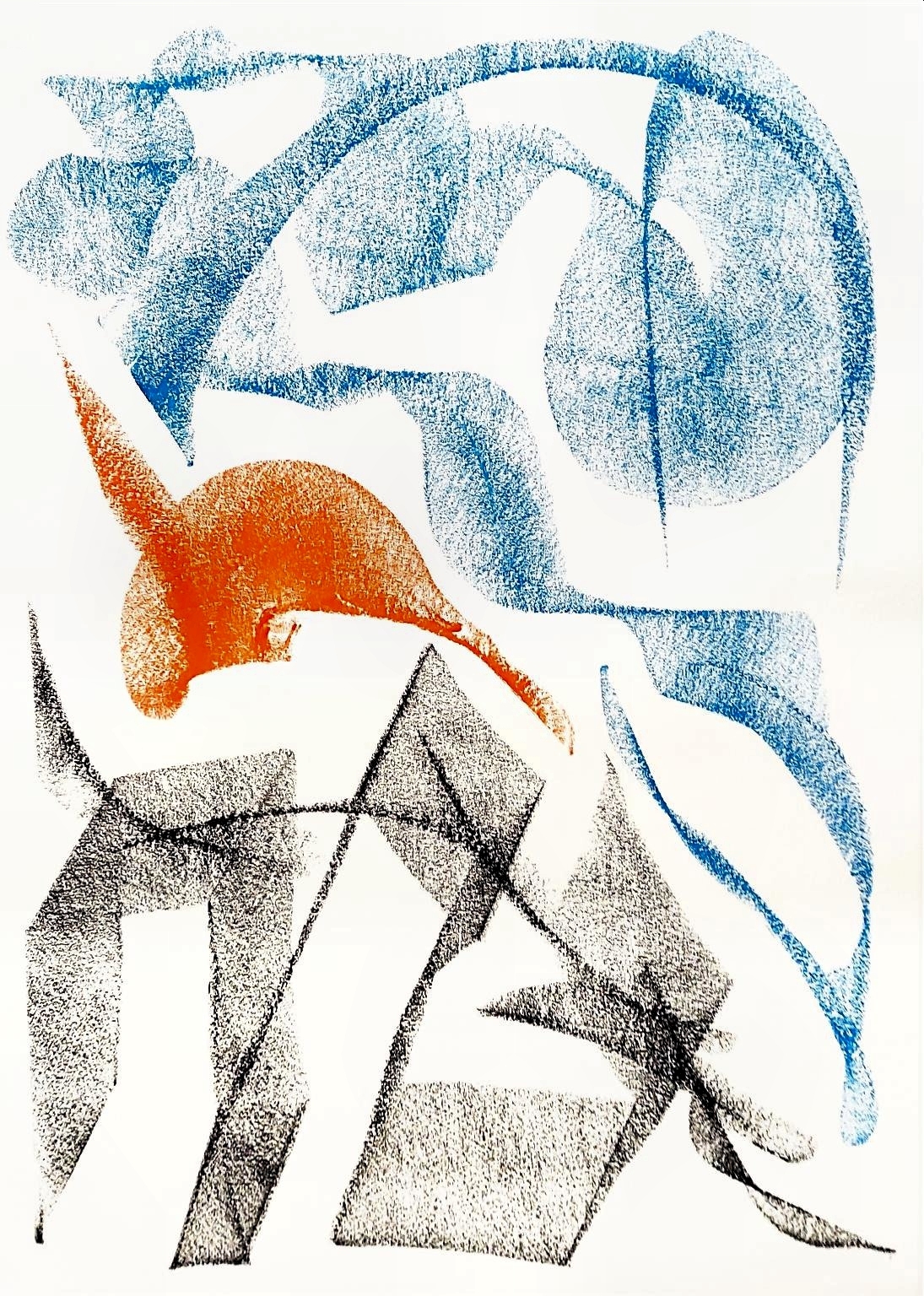
Nameless Number Eighteen: Force and Retention
Nameless Number Eighteen makes this recording relation unusually explicit. The artifact was produced with Paul Rubens jumbo oil pastels on a 22 × 30-inch sheet of Canson XL Mixed Media paper. Most blue and black trajectories were described as executed at approximately half power, while the orange trajectory received full bodily force. The denser orange passage retains a difference in the production event, but it should not be mistaken for a calibrated measurement of force. The sheet records material consequences, not physical units.
The blue and black fields also received same-color overlays. Later movements crossed areas already modified by earlier deposits without functioning as corrections. Each passage encountered a surface with a material past, and the support retained successive causal strata. What is recorded is therefore not only where the body moved, but how later contact met the consequences of earlier contact.
The comparison with the preceding UArt works is equally important. Their more abrasive surfaces interrupted oil-pastel deposition even when bodily force increased. In Number Eighteen, the Canson XL surface permitted more continuous retention. The trajectile could continue in either condition; what changed was the substrate–medium system's capacity to register it.
Evidence Without a Total Transcript
The finished artifact cannot reconstruct the event by itself. A dense passage may support an account of greater pressure, slower movement, repeated contact, a softer medium, or some combination of these. Documentation is required to distinguish among possible causes. The trace is evidence, but it is not self-interpreting.
Indexical continuity does not automatically authenticate a maker or uniquely identify a body. Likewise, a photograph or generated resemblance may preserve an appearance without preserving the original deposits, relief, contact history, or material sequence. That distinction is examined directly in The Human Physical Trace in the Age of Generative Imagery.
Where Somacentric Trajectilery Becomes Specific
Embodied drawing, performative drawing, automatism, body printing, and motion recording all provide legitimate historical bridges. They establish that bodies can generate marks, serve as surfaces or instruments, and leave residues across different media. None of these terms alone defines Somacentric Trajectilery.
The Somacentric distinction lies in the conjunction of conditions: bodily trajectory enters material contact; conscious control is restricted from designing the emerging image; local duties may remain active; resistance and contingency are allowed to alter what occurs; and the resulting artifact is preserved as the irreversible record of that event.
The body is therefore not substituted for the mind as a romantic source of truth. It functions within a protocol that redistributes authority. Intention establishes conditions without possessing the whole result, while matter records only what the encounter allows it to retain.
“The body as recording instrument” names the recognizable curatorial bridge. “Somacentric Trajectilery” becomes necessary where that bridge can describe bodily inscription but cannot yet explain the restrictions governing how the trace was allowed to emerge.
References and Further Reading
The following sources establish the historical and theoretical vocabulary used in this essay. Arteanity-specific claims remain grounded in the linked archive and artifact records.
- Butler, Cornelia H., and Catherine de Zegher. On Line: Drawing Through the Twentieth Century. Exhibition and catalogue. The Museum of Modern Art, 2010.
- Hutchinson, Scout. “With Uncertainty: Drawing and Change.” Whitney Museum of American Art.
- Whitney Museum of American Art. “David Hammons.” Artist and collection record.
- Walker Art Center. “If You Couldn’t See Me: The Drawings of Trisha Brown.” On Performativity.
- The Museum of Modern Art. “André Masson. Automatic Drawing. (1924).” Collection record.
- Leigh, Brooke. “Trace and Catharsis: Embodied Drawing.” Drawing: Research, Theory, Practice 7, no. 1 (2022): 79–98.
- Iversen, Margaret. “Index, Diagram, Graphic Trace: Involuntary Drawing.” Tate Papers no. 18, 2012.