Non-Objective Drawing, Structural Abstraction, and the Trajectile
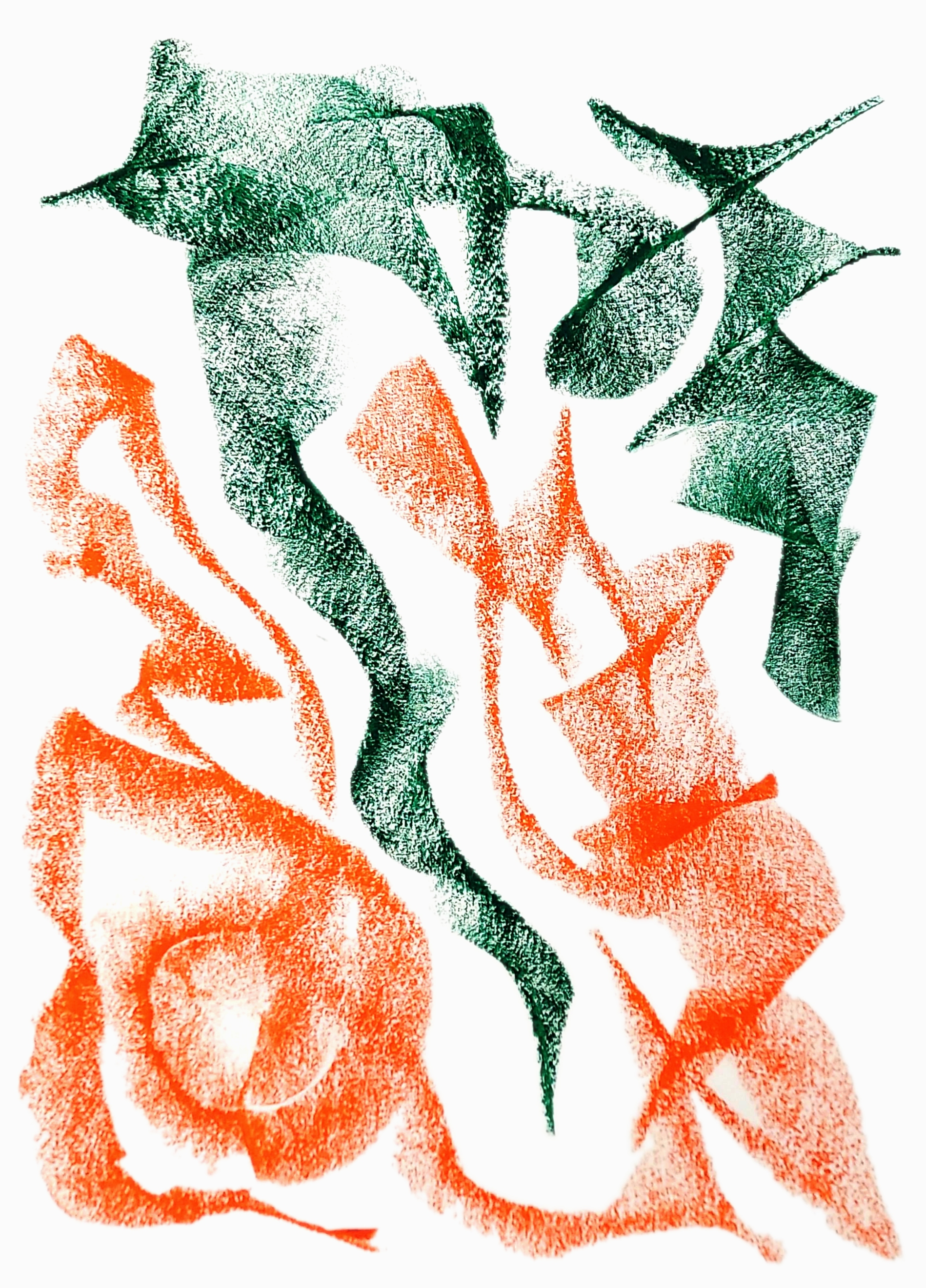
Non-objective drawing need not depict an external subject in order to establish relations among lines, fields, intervals, densities, and edges. A Somacentric Trajectile can be examined through those relations, but its visible organization should not be mistaken for evidence of a predetermined compositional plan. In Nameless Number Twenty Three, green and orange deposits form distinct spatial tensions while the documented fracture of the pastel contributed to a circular deposition. Rotation changes the viewer's reading without changing the artifact's material history. Structural analysis describes the result; the event record explains conditions that visual analysis alone cannot establish.
Structure is present in the finished Trajectile without necessarily having governed its production. Non-objectivity concerns representation; structural reading concerns relations; Somacentric specificity concerns the event through which those relations emerged.
What Non-Objectivity Describes
Non-objective art offers a vocabulary for work whose forms do not depend on depicting an identifiable external subject. It directs attention toward relations of line, color, interval, scale, and density rather than asking first what the image represents.
This does not make the work empty of association or meaning. Nor does non-objectivity specify one method of production. A nonrepresentational arrangement can be meticulously planned, repeatedly revised, improvised, or generated under constraints. The category describes a relation to representation, not a guarantee of spontaneity.
The Guggenheim's account of Kandinsky's Composition 8 attends to interacting circles, triangles, and linear elements. Such language demonstrates how an abstract work can be discussed through its internal relations. It does not require the critic to translate every form into an external object.
Somacentric Trajectilery can be approached through this kind of reading, provided the visible organization is not confused with the procedure that brought it into existence.
Structure Does Not Necessarily Mean a Prior Plan
Composition has two relevant senses: the activity of arranging a work and the arrangement encountered once it exists. The same word can therefore conceal a consequential difference. To identify a composition in a finished Trajectile is not to demonstrate that its relations were planned or corrected into place.
Structural abstraction is used here descriptively, not as the name of a newly asserted historical movement. It concerns how nonrepresentational elements enter relations: a band narrows beside an open interval, a dense deposit redirects attention, or a curved passage appears to gather several separated areas.
These relations can be described precisely without turning them into proof of an original intention. Formal analysis establishes what is available to perception. Production history addresses how it came to be available. Neither account substitutes for the other. The distinction between emergent structure and a prior mental image is developed in Before Composition.
Reading Twenty Three Without Supplying a Subject
Nameless Number Twenty Three provides a concrete case. Its green and orange fields offer differences of density, curvature, and extent. Broad deposits narrow into more attenuated passages; open paper separates colored regions while also linking the sheet as a continuous field.
The orange circular deposition can organize attention without having been planned as a compositional center. The artifact record connects its formation to a fractured pastel whose two fragments continued recording within the same event. This causal account changes the status of the visible form: it can be structurally consequential without being the execution of a prior design.
Nor must the green and orange configurations be assigned identities as creatures, objects, or signs. Such associations may occur, but the work remains available to a more exact description of where the material thickens, where a passage turns, and where the paper remains exposed.
Calling an area dominant or an interval tense is an interpretive observation. It should not silently become the claim that the artist intended dominance or tension at that location.
Negative Space and the Consequences of Contact
Negative space is not simply the unimportant remainder around a principal mark. In a Trajectile, exposed substrate can separate trajectories, open a passage, or make a dense deposit legible. Its boundaries are established through the contacts and noncontacts that occurred.
The distinction becomes especially clear in Nameless Number Seventeen, whose record describes interrupted pastel contact and porous fields on an abrasive support. Some intervals belong to the material reception of the action, rather than to a later decision to reserve shapes as negative space. Their causal material conditions are examined in Material Resistance and the Physical Trace.
Formal reading may treat these intervals as active relations while retaining that causal qualification. A gap can function compositionally for the viewer even when it was not designed as a compositional device. Conversely, not every exposed area can be assigned a particular physical cause from the image alone.
Orientation Changes the Reading, Not the Event
The archive identifies four valid orientations for Twenty Three rather than an intrinsic top. Rotation changes which passages appear to rise, descend, support, or interrupt. It can bring a different region into prominence and produce or dissolve a figurative association.
The material relations also retain continuities. Neighboring deposits remain neighbors; a crossing retains its material sequence; a fracture does not acquire a different production history because the sheet is turned. Orientation changes the encounter with the work without restarting the event.
This distinction prevents two opposite errors. No single presentation need be mistaken for the only authorized reading, but multiple orientations do not make every interpretation equally well supported. A reading must still attend to the actual deposits and intervals.
Orientation freedom is also not a license to ignore conservation or mounting conditions. The conceptual availability of another orientation and the safe handling of the physical object are different questions.
The Trajectile as Structure and Retained Event
A non-objective reading establishes why the work need not depict something in order to sustain attention. A structural reading specifies relations within the finished artifact. Neither, by itself, explains the restricted conscious control, material contingencies, and preutilitarian conditions involved in a Somacentric event.
The term Trajectile keeps those levels connected. It names a finished artifact that can be examined as an organized field while remaining the retained consequence of a trajectory. Its structure is neither dismissed as mere accident nor retrospectively converted into evidence of a design.
Within Arteanity, this connection allows formal experience and causal provenance to inform one another. The viewer can follow the internal relations of the work, then return to the documented encounter that produced them. What becomes legible is not simply an image without a subject, but structure emerging through an event whose final form was not fully prescribed.
References and Further Reading
The following sources establish the historical and theoretical vocabulary used in this essay. Arteanity-specific claims remain grounded in the linked archive and artifact records.
- Spector, Nancy. “Composition 8.” Guggenheim Museum Bilbao; adapted from Guggenheim Museum Collection A to Z, 2001.
- Solomon R. Guggenheim Museum. “Kandinsky.” Exhibition resource, 2009–10.
- The Museum of Modern Art. “Abstraction.” Art Terms.