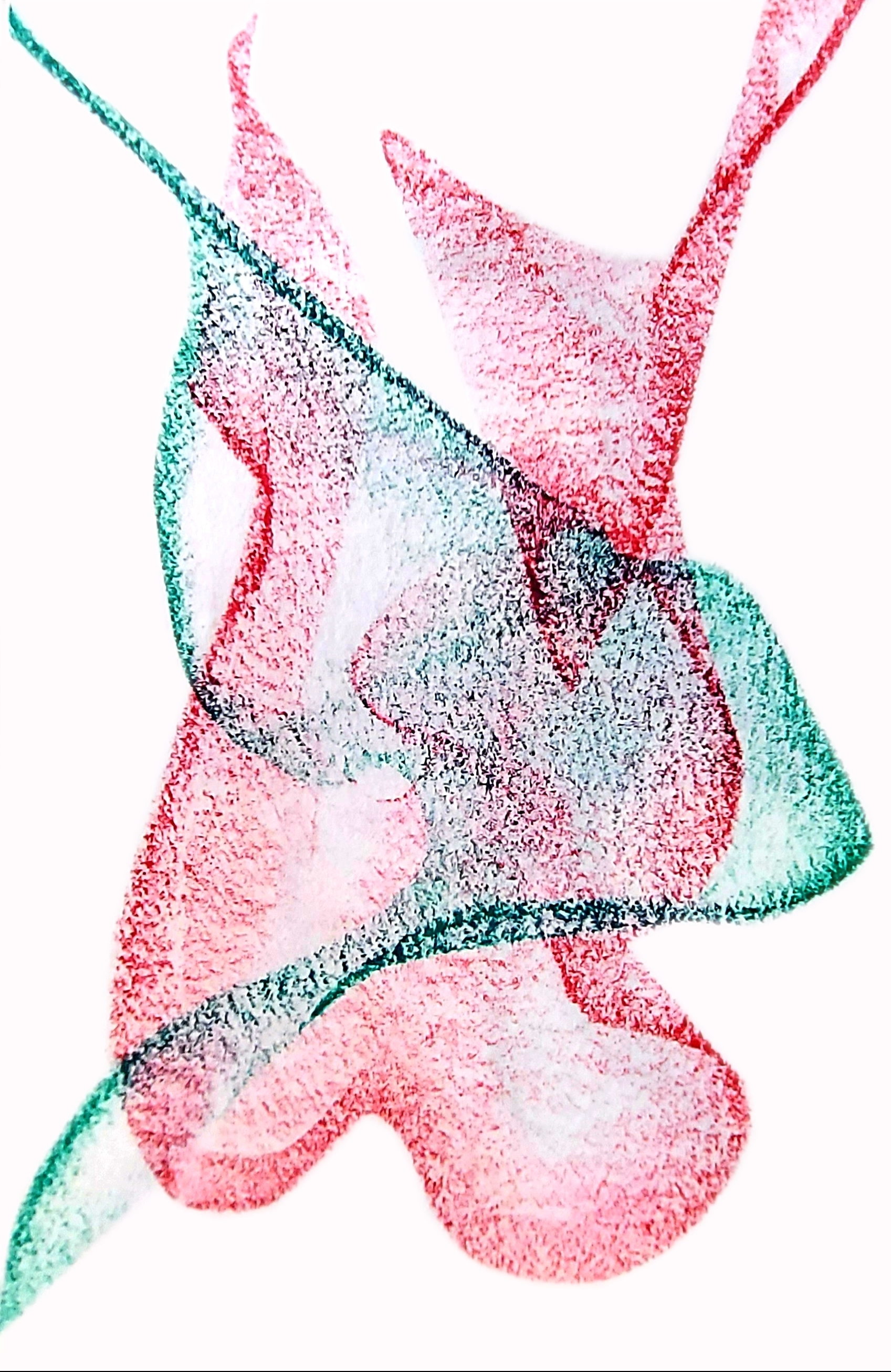
Somacentric Trajectilery and Gestural Abstraction
Gestural abstraction identifies the visible importance of bodily action, but it becomes insufficient when the question shifts from how a mark looks to how authority was distributed during its production. In Somacentric Trajectilery, intention selects conditions and initiates the event while stated protocols restrict its power to redirect emerging traits toward a preferred image. Bodily motion, material resistance, collision, breakage, evasion, and deposition jointly determine the irreversible trace. Gestural abstraction therefore remains a valid historical bridge, but the discipline requires the more specific concepts of preutilitarian timing, restricted compositional authority, and material participation.
The boundary is crossed when bodily gesture is no longer adequately understood primarily as expressive form and must instead be examined through the protocol governing its release, the restricted authority of intention, and the material encounter that determines what remains.
Gestural Abstraction, Embodied Drawing, and Bodily Gesture
Gestural abstraction provides an important historical point of orientation for Somacentric Trajectilery. Within Abstract Expressionism, Action Painting, gestural mark-making, and related approaches, bodily movement ceased to function merely as a means of producing an image and became visibly present in the work itself. Speed, pressure, direction, repetition, interruption, and physical reach could remain legible in the resulting mark.
This shift is essential to understanding Somacentric Trajectilery. The trace is not conceived as a neutral line subsequently arranged into a composition. It records an event in which bodily motion acts directly upon material.
The historical vocabulary is therefore genuinely relevant. Somacentric Trajectilery belongs near discussions of gestural abstraction, non-objective drawing, expressive drawing, and Action Painting because all recognize that the act of making may remain materially present in what is made.
Related discussions of embodied and performative drawing likewise treat bodily movement as constitutive of the mark rather than as a neutral means of execution. These terms broaden the historical field of reference; they do not mean that every bodily trace is a performance, or that Somacentric Trajectilery is reducible to performance art.
Where the Comparison Holds
The strongest point of contact is the displacement of representation by action.
A Somacentric Trajectile does not begin with the intention to depict an external subject. Its lines, crossings, interruptions, concentrations, and open spaces emerge through bodily movement rather than through the rendering of a preconceived image.
In this respect, the familiar idea of the surface as an arena of action remains useful. The body enters a physical situation; the medium encounters the substrate; movement produces a visible record.
But this shared territory describes only the beginning of the comparison.
Where Gestural Abstraction Becomes Insufficient
Gestural abstraction usually identifies the visible importance of gesture. Somacentric Trajectilery places a more specific restriction on the authority governing that gesture.
The discipline does not merely ask that the movement be expressive, spontaneous, forceful, or bodily. Stated protocols restrict conscious control so that the emerging trace is not continuously redirected toward a preferred composition, recognizable image, narrative purpose, or predetermined trait.
This distinction changes the status of the gesture.
The body is not simply being used more freely to execute an artistic intention. Instead, conscious intention establishes conditions and initiates the event while surrendering complete authority over what the finished trace must become.
Somacentric Trajectilery therefore cannot be reduced to another name for gestural abstraction. Gestural abstraction provides a historical adjacency; it does not fully describe the distribution of authority within the event.
The Preutilitarian Interval
This difference can be understood through the concept of Preutilization and the interval before a mental image governs production.
Preutilization does not replace the name Somacentric Trajectilery. It identifies the temporal condition in which the discipline operates: the interval before an emerging trace has been assigned a governing purpose, image, compositional role, or predetermined trait.
Every event still contains intention. A material is selected. A substrate is chosen. Rules may be established. The body begins from somewhere. What is withheld is not agency itself, but the authority of a completed target state.
The work is therefore not produced by executing a picture already held in the mind. It discovers its form by occurring.
This also distinguishes Preutilization from a loose appeal to spontaneity. Spontaneity can still serve a predetermined image. Improvisation can still be edited toward an aesthetic goal. In the preutilitarian interval, emerging traits are not immediately converted into obligations.
A line is not required to become something else simply because it has appeared.
Material Resistance and the Irreversible Trace
The resulting event is not determined by the body alone.
Material resistance, friction, pressure, loss of contact, collision, crossing, breakage, evasion, and material deposition participate in determining the trace. The physical medium can interrupt or redirect movement. A pastel may fracture. A textured surface may cause a line to skip. Previously deposited material may intercept a later trajectory.
These are not necessarily defects to be corrected back toward an original composition. They become part of the event's irreversible history.
This material participation is especially visible in works such as Nameless Number One and Nameless Number Five. In the former, dry pastel records velocity through fractured, porous contact with the substrate. In the latter, resistant oil pastel accumulates physical relief as successive trajectories encounter material already deposited on the surface.
The artifact is therefore neither a pure expression of intention nor a passive record of bodily movement. It is the residue of an encounter among protocol, body, material, resistance, contingency, and time.
From Gestural Abstraction into Arteanity
Gestural abstraction offers a useful route toward Somacentric Trajectilery because it already permits the viewer to understand the mark as evidence of action rather than simply as representation.
Somacentric Trajectilery proceeds further by asking what may occur when the emerging event is protected, for a critical interval, from being subordinated to a predetermined result.
Within Arteanity, this connects Somacentric Trajectilery to a wider concern with premature closure. Deutilization acts after prescribed function has acquired authority and reopens possibilities that function has narrowed. Somacentric Trajectilery acts earlier, preserving possibility before assignment becomes sovereign.
The relationship can therefore be stated simply:
Deutilization releases possibility after assignment. Somacentric Trajectilery preserves possibility before assignment.
Gestural abstraction helps locate the territory historically. The concept of the preutilitarian interval identifies where Somacentric Trajectilery departs from that history and establishes its own operational condition.
References and Further Reading
The following sources establish the historical and theoretical vocabulary used in this essay. Arteanity-specific claims remain grounded in the linked archive and artifact records.
- Paul, Stella. “Abstract Expressionism.” Heilbrunn Timeline of Art History. The Metropolitan Museum of Art, 2004.
- Tate. “Action Painting.” Art Terms.
- The Museum of Modern Art. “Franz Kline. Chief. 1950.” Collection record.
- Butler, Cornelia H., and Catherine de Zegher. On Line: Drawing Through the Twentieth Century. Exhibition and catalogue. The Museum of Modern Art, 2010.
- Leigh, Brooke. “Trace and Catharsis: Embodied Drawing.” Drawing: Research, Theory, Practice 7, no. 1 (2022): 79–98.