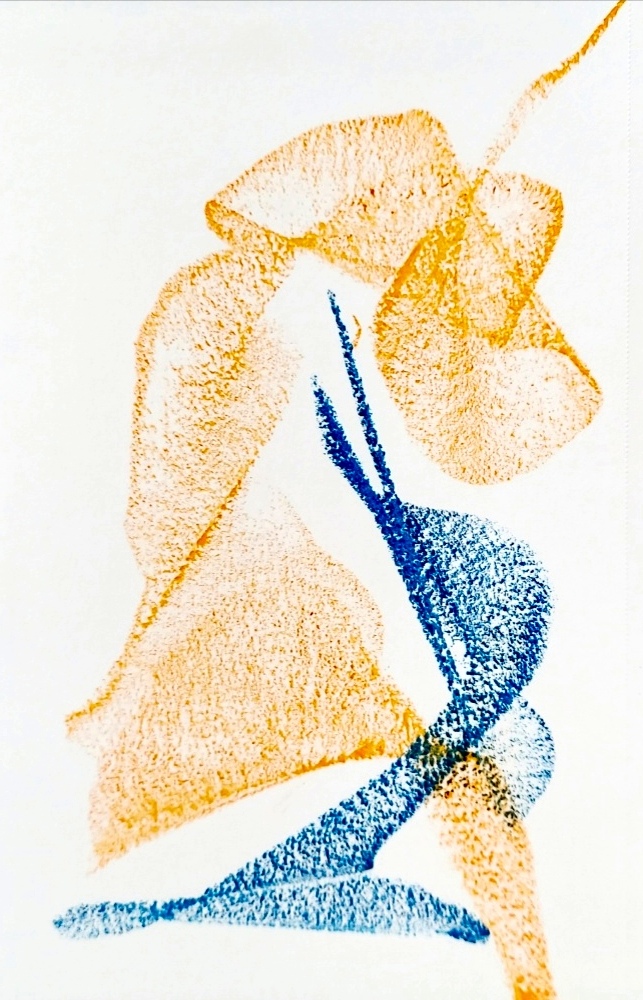
Somacentric Trajectilery and the Indexical Trace
An indexical trace is connected to an event by physical causation rather than resemblance alone. A Somacentric Trajectile is indexical because its marks are deposits and disruptions produced through actual contact among a moving human body, a tool or medium, and a substrate. Its fractures, skips, crossings, pressure changes, and accumulations are not images of an event; they are material consequences of it. Indexicality, however, does not by itself define Somacentric Trajectilery. The discipline also depends on stated protocols, restricted conscious control, preutilitarian timing, and the material event's participation in determining the finished trace.
Somacentric Trajectilery does not claim significance because its artifacts look gestural. Their indexical force lies in causal continuity with the bodily-material events that produced them; their disciplinary specificity lies in the protocols governing those events.
What an Indexical Trace Is
Indexicality offers a precise way to understand a mark as evidence of an event rather than simply as an image.
In the semiotic tradition associated with Charles Sanders Peirce, an index is a sign connected to its object through an actual or existential relation. Smoke indicates fire because the fire produced it. A footprint indicates contact because a body displaced the ground. The connection does not depend primarily on resemblance or convention; it depends on something having occurred.
Within art, an indexical trace may therefore register contact, pressure, movement, duration, absence, or the former presence of a body or material. A trace can resemble its cause, but resemblance is not what makes it indexical. A pressure mark does not need to look like the hand that made it. Its significance lies in the physical relation between the mark and the event.
In contemporary drawing and performance-related practice, this field is also described through embodied mark-making and drawing as the residue of performance: the finished surface retains physical consequences of an action that has passed. These terms locate Somacentric Trajectilery within a recognizable curatorial conversation, but they do not yet identify the protocols governing the action.
This distinction provides an important point of entry into Somacentric Trajectilery.
From Resemblance to Causal Provenance
A mark can look forceful, spontaneous, fractured, or bodily without being the physical remainder of the event it appears to describe.
A reproduction can preserve the appearance of a trace. A copied gesture can imitate its form. A generated image can reproduce the visual signs of pressure, speed, or broken contact. In each case, resemblance may be convincing while the original causal chain is absent.
Causal provenance asks a different question: not what does this mark look like, but what produced this particular material fact?
For a physical trace, the answer may include a body, an instrument, a medium, a substrate, and the succession of contacts through which matter was deposited, displaced, fractured, or withheld. The trace is connected to an occurrence that cannot be replaced by visual similarity alone.
This does not make resemblance and indexicality mutually exclusive. A sign may function in more than one way. The important distinction is that indexical force arises from a real connection, not from appearance by itself.
The Somacentric Event as a Causal Chain
A Somacentric Trajectile is indexical because the finished artifact remains causally connected to the bodily-material event that produced it. The selective bodily registration within that event is examined further in The Body as Recording Instrument.
The event begins with stated conditions. A medium and substrate are selected. A tool or method of contact may be chosen. Rules restrict how conscious control can intervene. The body then initiates movement before a predetermined image or completed compositional target can become sovereign.
From that point, the trajectory is physical. Muscular motion passes through the hand or tool into the medium. The medium meets the substrate. Friction slows or interrupts contact. Pressure changes deposition. Previously deposited material may intercept a later movement. A stick may fracture, skip, turn, or lose contact.
The resulting mark is not a depiction of these encounters. It is one of their consequences.
The causal chain can contain mediation without becoming indirect in the representational sense. A pastel, a coupling, or another tool may stand between hand and substrate, yet it remains physically active within the same event. Somacentric directness therefore does not mean the absence of material mediation. It means that bodily action reaches material without first being subordinated to a predetermined image.
Material Evidence in the Genesis Corpus
Nameless Number One and Nameless Number Five make different aspects of this indexical condition visible.
In Nameless Number One, dry pastel records velocity through fractured, porous contact with the paper. The broken continuity of the deposited line is not an illustration of speed added after the fact. It is a physical consequence of motion, pressure, the pastel's consistency, and the substrate's surface meeting in time.
Nameless Number Five records another material condition. Resistant oil pastel accumulates into low relief, and successive trajectories encounter material already present on the sheet. Crossings and compressed deposits preserve a temporal order: a later movement does not merely appear above an earlier one; it physically meets the earlier deposit.
Neither artifact reduces the event to an unmodified expression of bodily intention. Each retains evidence of negotiation among protocol, anatomy, medium, substrate, resistance, and contingency.
The trace is therefore bodily without belonging to the body alone.
Where Indexicality Becomes Insufficient
Indexicality identifies a real connection, but it does not by itself define Somacentric Trajectilery.
Many physical artworks contain indexical marks. A carefully controlled brushstroke may record the hand that made it. A staged imprint may preserve direct contact. An accidental stain may register an event. Each can be indexical without operating under Somacentric conditions.
An index is also not automatically a guarantee of truth, authorship, identity, or significance. A trace does not interpret itself. Its material history must be supported by provenance, documentation, and the conditions under which it was produced. For this reason, a Somacentric Trajectile should not be described simply as a biometric signature or a self-authenticating proof of presence.
The disciplinary distinction lies elsewhere. Somacentric Trajectilery joins causal continuity to stated protocols that restrict conscious control, protect the preutilitarian interval, and permit material resistance to participate in determining the finished artifact.
Indexicality explains why the trace is evidence of an event. It does not fully explain what kind of event was allowed to occur.
From the Indexical Trace into Arteanity
The concept of the indexical trace changes how a Somacentric artifact is encountered. The viewer is not asked only to interpret a configuration of lines and colors. The surface can also be read as material evidence: deposits, interruptions, fractures, crossings, and open intervals remain connected to a specific sequence of physical events.
This connection is important within Arteanity, where creative force is examined through the structures, systems, materials, actions, and traces into which it enters.
Somacentric Trajectilery preserves that entry before an emerging trait is compelled to serve a predetermined image or purpose. The artifact is not valued because it resembles uninhibited gesture. It matters because its material facts remain causally continuous with an event whose outcome was not fully authorized in advance.
The indexical trace therefore supplies a recognized theoretical bridge. It establishes the difference between the appearance of action and the material consequence of action.
At the point where indexicality can say that an event left a trace but cannot explain the governing conditions of that event, the specific vocabulary of Somacentric Trajectilery becomes necessary.
References and Further Reading
The following sources establish the historical and theoretical vocabulary used in this essay. Arteanity-specific claims remain grounded in the linked archive and artifact records.
- Atkin, Albert. “Peirce’s Theory of Signs.” Stanford Encyclopedia of Philosophy. Substantive revision 2022.
- Butler, Cornelia H., and Catherine de Zegher. On Line: Drawing Through the Twentieth Century. Exhibition and catalogue. The Museum of Modern Art, 2010.
- Leigh, Brooke. “Trace and Catharsis: Embodied Drawing.” Drawing: Research, Theory, Practice 7, no. 1 (2022): 79–98.
- Iversen, Margaret. “Index, Diagram, Graphic Trace: Involuntary Drawing.” Tate Papers no. 18, 2012.