The Human Physical Trace in the Age of Generative Imagery
A human physical trace is distinguished by the event that produced it, not by a reliably identifiable appearance. Generative imagery can depict the visual characteristics of gesture, while a photograph can document an actual artifact without becoming that artifact. Machine-driven drawing can also leave genuine material traces, so physicality alone does not establish human authorship or Somacentric conditions. The relevant questions concern which body or apparatus acted, what contacted the substrate, and how the event was governed and documented. Somacentric Trajectilery locates its specificity in a human bodily-material event under restricted conscious control, not in a claim that digital or machine-assisted art lacks value.
A depiction of bodily action, a photographic record of an artifact, and the artifact produced by that action have different causal histories. The Somacentric distinction requires a documented human bodily-material event, not merely the appearance of a human gesture.
A Question of Production, Not a Visual Test
A broken line, irregular pressure, or a seemingly spontaneous sweep can suggest bodily action. None of these appearances alone establishes the process that produced a particular image. The same visual feature can be encountered in an original drawing, a photograph of that drawing, a reproduction, or a generated image.
This does not make the distinctions irrelevant. It changes the question. Instead of asking whether an image looks sufficiently human, causal provenance and indexical continuity ask what happened: what acted, through which instruments, upon which material, and under what conditions?
For Somacentric Trajectilery, the answer includes a human body acting through a medium upon a substrate, with restrictions on conscious control and on the subordination of emerging traits to a predetermined image. Visual resemblance can invite inquiry, but it cannot certify that account.
An Artifact, Its Photograph, and a Generated Depiction
A photograph of an existing Trajectile is a record made through a further event of imaging. Its relation to the artifact matters, but the photograph does not contain the same deposits, surface relief, dimensions, or responses to changing light. It makes selected aspects of the work accessible through another medium.
A generated depiction of a pastel gesture need not refer to a particular pastel-on-paper event. It may present convincing signs of texture and contact without documenting that specific occurrence. This does not imply that digital images lack causes: computation, human decisions, source materials, and display systems all belong to their histories. It means their causal histories must not be confused with the bodily-material event they may appear to depict.
The distinction remains relevant if a generated image is printed. Printing produces a physical object and a material trace of the printing process. It does not retrospectively turn the depicted gesture into the event that produced the original image.
Machine Drawing Complicates a Simple Opposition
Machines can make material marks. The Whitney's exhibition of Harold Cohen's AARON describes software connected to plotters and painting machines that placed pen and brush marks on paper. Such marks are not immaterial merely because code participated in their production.
Contemporary collaborations further complicate the boundary. The V&A's account of Sougwen Chung's MEMORY describes simultaneous drawing with a robotic system informed by an archive of the artist's drawings. The museum acquired a collaborative drawing together with a version of the model and video documentation.
The conclusion is not that every causal trace is equivalent. It is that physicality and authorship are separate questions requiring a specified workflow. A robotic mark can be indexical to a real mechanical event without being evidence of the same kind of human bodily encounter claimed for a Somacentric Trajectile.
Thirteen: What a Single Image Cannot Contain
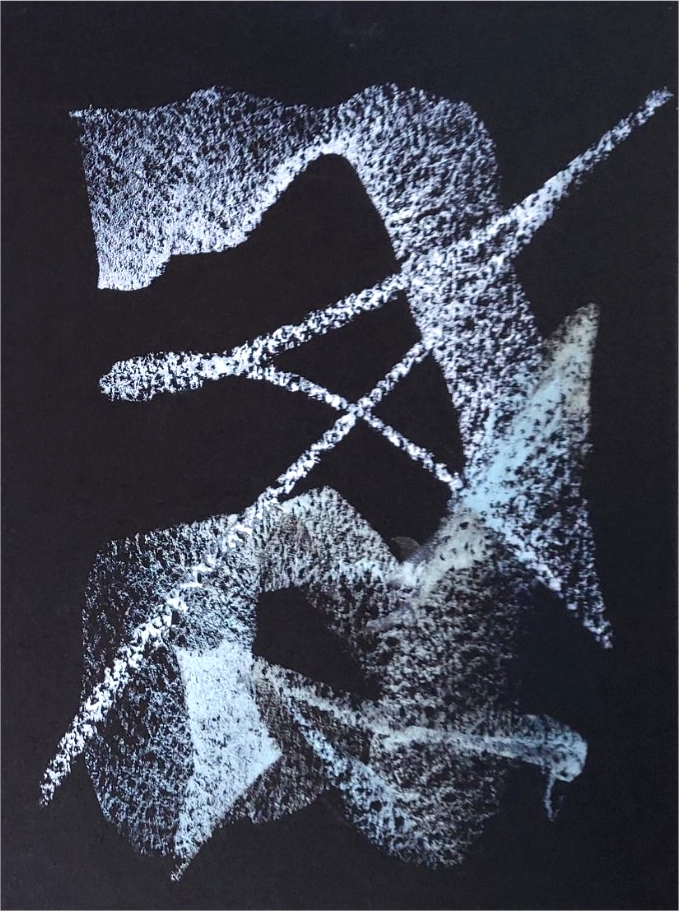
Nameless Number Thirteen makes the limits of visual substitution concrete. The artifact record describes simultaneous two-handed use of white Sakura Cray-Pas Expressionist and Sennelier iridescent blue oil pastel on black Strathmore paper. The two streams were produced within one event, not as successive color layers.
Its documented material behavior also matters. White remains comparatively stable while the blue varies with illumination and viewing angle. A frontal photograph can record one presentation of this relation; it cannot by itself deliver the range of encounters available with the physical surface.
Neither simultaneity nor the full production sequence can be established simply by looking at that photograph. The image must be read with the artifact record and its supporting documentation. The selective relation between bodily event, retained trace, and documentation is examined in The Body as Recording Instrument. The point is not that every material property is unique to human art, but that the identity of this work includes more than the appearance of one captured view.
Evidence Without Self-Authentication
A physical trace does not automatically authenticate its maker. Nor does irregularity function as a biometric certificate. Provenance depends on the relation among the object, its recorded conditions, production documentation where available, and the claims made for it.
Nameless Number Nineteen, for example, is documented as continuing while pastel remnants detached from a provisional holder. The resulting sheet and the account of material loss support an inquiry into a particular event. A photograph resembling that sheet would not establish that the same depletion occurred.
These distinctions do not require predictions about what future machines could never do. They require accuracy about the event being described. They also do not rank every human-made artifact above every computational work. Causal specificity is a basis for understanding a work, not an automatic verdict on its artistic significance.
Creation and Articulation within Arteanity
Arteanity's own statement on AI, authorship, and the human trace discloses substantial AI assistance in the archive's writing and analysis. It distinguishes that reflective activity from the physical production of the artifacts and assigns final responsibility for the public record to Viktor Genel.
This division must remain visible. An AI-assisted interpretation is not eyewitness evidence of a production event, and its fluency does not validate a material claim. Descriptions need to be checked against the artist's account, the artifact, and the available documentation.
Somacentric Trajectilery therefore does not need to retreat from contemporary tools to preserve its distinction. It needs to keep making, imaging, description, and interpretation from being treated as interchangeable acts. The human physical trace matters because a specified encounter occurred and left material consequences, not because an image has passed a test of looking human.
References and Further Reading
The following sources establish the historical and theoretical vocabulary used in this essay. Arteanity-specific claims remain grounded in the linked archive and artifact records.
- Whitney Museum of American Art. “Harold Cohen: AARON.” Exhibition resource, 2024.
- Mitchell, Katherine. “The Algorithmic Gesture: Sougwen Chung’s MEMORY.” Victoria and Albert Museum, 2022.
- Victoria and Albert Museum. “Collection Selection Boxes: Artificial Intelligence.” Collection research resource.
- Brookes, Gareth. “Truth Claims and Trace: The Autographic Witness in the Algorithm.” Memory, Mind & Media 4 (2025): e21.