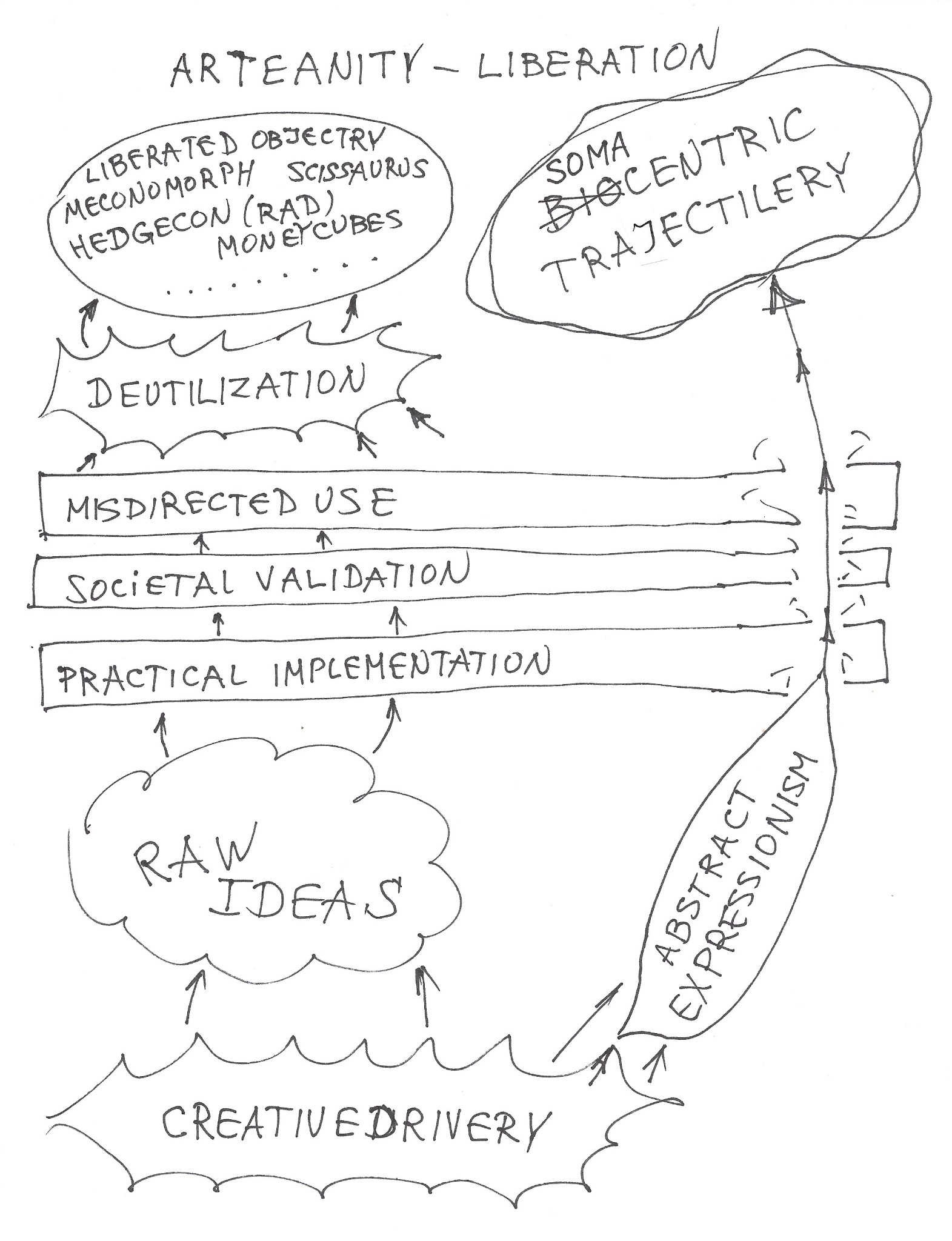
The Emergence of Somacentric Trajectilery
The conscious search began probably around 2024 and became pressing by 2025, before the first physical realization on May 28, 2026. The earlier literary piece Geometr now offers a way to recognize the question in an emotional, preconscious form. Somacentric Trajectilery permits bodily force to enter material while relinquishing authority over the result.
The anticipation of Utilization can inhibit creation before an object exists to be liberated. Acting without a prescribed destination offers a practical response; it does not remove material limits, consequences, or the possibility of later critical judgment.
The Point That Does Not Continue
In my unfinished literary piece Geometr (The Geometer), a man has placed a point and does not proceed. The surrounding world anticipates a continuation. A point seems insufficient: surely it must begin a line, a figure, a construction, a statement. Yet the Geometer has made no promise to deliver any of these things. What others experience as an incomplete beginning may be, for him, a threshold he cannot bring himself to cross.
He possesses the ability to do whatever he wishes. The difficulty is not a lack of power. Neither is his immobility a reasoned declaration that he has chosen freedom over obligation. His fingers grip the pencil until they turn blue; the pencil trembles. Something is being experienced bodily before it has become a proposition. Creative force is present, but its force is expended in holding movement back.
Returning to the piece now, I recognize a possible apprehension beneath that tension: any movement beyond the original point might open a floodgate. Once something definite begins, relations, expectations, interpretations, and demands can follow. A second mark need not merely extend the first. It may initiate a process in which each consequence recruits the next action into its service.
This is a present interpretation of an earlier work, not a claim that the Geometer secretly possessed the vocabulary of Arteanity. The point functions here as a literary singularity, not as a mathematical proof of unlimited possibility. What matters is the emotional pressure at the boundary between having creative capacity and committing that capacity to a course.
The piece remains unfinished. Its suspension may nevertheless reveal something that a completed construction would conceal: the anticipation of Utilization can arrest an act before there is an object to liberate. The question can be felt long before it is consciously asked.
What Deutilization Could Release
With Deutilization, this concern acquired a material procedure. A business card is introduced into the world as an instrument of professional identification and exchange. Its familiar purpose can become so dominant that its other capacities scarcely register. In MeconoMorph, the card enters structural relationships that make those capacities available to attention. The material has not changed its past; its prescribed task has lost its exclusive authority.
Deutilization does not require the claim that usefulness is inherently wrong. Practical purposes make ordinary life possible. The problem begins when a purpose becomes an exhaustive account of what a thing is, or a command determining everything it may become. Under that condition, utility conceals as much as it enables. Liberation means interrupting the command so that neglected properties and relationships can appear.
The exhibition reception of the MeconoMorph works during 2024 and 2025 gave this inquiry a public life. Objects developed through Deutilization could engage viewers who did not first know the conceptual argument. That reception mattered to me, but it did not settle the philosophical question. A work's visual success could demonstrate that the procedure was artistically productive without proving that its account of freedom was complete.
As the practice became more convincing, its limitation became harder to overlook. Deutilization begins after an assignment has occurred. Something has already been designated, made useful, enclosed in an identity. The method performs a release from that condition. It cannot, by itself, explain how to keep the condition from becoming authoritative in the first place.
I began consciously searching for a preventive methodology probably around 2024. I cannot give that recognition an exact date. By 2025, the question had become almost unavoidable. The search preceded Somacentric Trajectilery; it was not invented afterward to connect an unrelated experiment to my earlier practice.
When Potential Acquires a Task
What I wanted to prevent was broader than practical use. An artistic composition can govern material as firmly as a manufactured function. If a finished image has already been appointed in thought, the emerging mark is judged by how well it serves that image. A work can be entirely nonrepresentational and still proceed under a predetermined demand for balance, intensity, elegance, or recognizable character.
The same concern extended beyond art. A professional achievement, a career, or an entire way of life can become a form of Utilization when it is installed as the destination that a person's capacities must fulfill. Possessing an ability is then converted into being obliged to employ it. Potential becomes a resource whose value is measured by its eventual performance.
This does not make every commitment an act of captivity. A chosen purpose can enable a life as well as restrict it. The question is what authority the purpose acquires: whether it remains open to reconsideration, or whether everything that emerges must justify itself before a destination already fixed. The Geometer's tension belongs near this question, before any clear distinction between external pressure and internal expectation has become available to him.
My search therefore concerned both utilitarian assignment and the authority of an anticipated outcome, to the extent that either could be suspended. It did not begin with a manageable division between useful objects and free art. Art itself could participate in the restriction. Even the ambition to produce a convincing image of freedom could give freedom a task to perform.
That possibility makes liberation difficult to formulate. If I decide in advance what liberated work must look like, I have already prescribed its conduct. If I require every act to demonstrate independence, independence becomes another obligation. A preventive methodology would have to leave room for an outcome that did not confirm the image of liberation with which I began.
Finding a Passage Through Gesture
My encounter with Oskar Vann's gestural work gave the search a concrete direction. His drawings remained in my thoughts. The attraction was not simply to a visual vocabulary I wanted to reproduce. Bodily movement appeared capable of entering material with an immediacy that suggested a different relationship between creative force and the formation of an image.
The early record of my response preserves the excitement of recognizing that possibility. I described it as a passage from the “RAW to the AWE.” That phrase records an encounter, not a guarantee of the viewer's response. Its significance lies in the shortened route: perhaps creative impetus did not have to become an idea for an image before it could have a material consequence.
Gesture alone could not answer the question. A rapid mark can obey a design; an apparently spontaneous passage can be adjusted until it produces a desired effect. Examining gestural approaches made the difference between the appearance of freedom and the conditions of an act increasingly important to me. A loose-looking image did not establish that its production had escaped an assigned destination.
Nor does this search establish that earlier artists had never worked without a complete plan. Automatism, Action Painting, and material process provide relevant historical comparisons, discussed elsewhere in the Theory section. My account here concerns the problem that brought me to the experiment. Historical resemblance neither settles that problem nor makes a new terminology sufficient evidence of a new achievement.
The practical possibility was to initiate a bodily-material encounter and attend to what emerged without treating the developing image as a proposal requiring improvement. The medium could strike, drag, resist, interrupt, or break. The resulting trace would first be a recording of the encounter. Its appearance could be examined afterward, without having served as the instruction that produced it.
May 28, 2026: The Search Becomes Material
Nameless Number One, made on May 28, 2026, was the first physical realization of what became Somacentric Trajectilery. That date identifies the beginning of the material practice. It does not identify the beginning of the question, and it should not imply that every later term or procedural distinction already existed at the first encounter.
The first works were discoveries under actual conditions. A body met a particular medium and support. The contact left something that could be retained, revisited, and compared. The material event supplied evidence that thinking alone could not provide: a form could emerge without my having first appointed that form as its destination.
This was not the disappearance of intention. I still chose to act, selected materials, and established circumstances. My body carried training, habits, memory, and preferences. No claim of absolute innocence could make those histories vanish. What changed was the authority granted to a projected result. The act did not need an image in advance to authorize its continuation.
Preutilization names the preventive aspect of this discipline. It concerns the interval in which an emerging feature has not been recruited to complete a required whole. Later procedures made the distinction more explicit. In Nameless Number Twenty One, avoiding intersections supplied a local duty; in Number Twenty Two, crossing supplied the contrary duty. Such constraints occupy attention and influence movement without specifying the finished artifact.
These developments should not be folded backward into the first work as a completed program. The conscious search came first; material experiments followed; vocabulary and procedural understanding developed through them. The continuity is real precisely because it includes discoveries, rather than requiring every subsequent insight to have been present at the beginning.
A Record That Changes Its Own Conditions
Once movement is allowed to continue, the surface is no longer merely an empty recipient. An earlier deposit can alter the friction encountered by a later passage. A stick's fracture changes the available contact. A collision can redirect a movement or bring it to an end. The record of what has happened becomes part of the conditions under which something else can happen.
This relation later made natural processes an illuminating comparison. A river's passage changes its bed, and the changed bed influences subsequent passage. The analogy concerns that reciprocal history, not a claim that water has artistic intentions or that a human hand can shed its nervous system and become a natural force without memory.
Nature has no compositional authority to relinquish. A person can establish conditions in which that authority is restricted. Somacentric Trajectilery enters the wider world of physical inscription through this specifically human difficulty: allowing consequences to develop without continually converting them into instructions for a desired picture.
“TRAJECTILE NEVER FAILS” belongs within that relation. It does not promise that materials will remain intact, that recording will be complete, or that every artifact will merit equal attention. It means that an unassigned trajectory cannot be condemned for missing a visual destination it was never required to reach. Breakage and interruption remain events to be accounted for, rather than automatic reasons to erase and restart.
The distinction leaves judgment available. A viewer may find an artifact compelling or unconvincing; a critic may question the protocol or its execution. Such judgments do not retroactively supply the act with a target. Preserving what occurred and evaluating what it offers are different responsibilities, both of which the archive must accommodate.
Crossing the Threshold
Seen from this later position, Somacentric Trajectilery suggests a possible exit from the Geometer's predicament. He holds force at the threshold because its release seems to threaten consequences he cannot emotionally accept. The discipline permits release without requiring him to determine in advance what those consequences must become.
He does not know that exit. The story should not be rewritten to make him demonstrate it. He may never move beyond his point. The connection belongs to my present understanding of the work: a pressure expressed in literature can become recognizable, much later, within a practical investigation. That recognition does not turn the earlier piece into a disguised manifesto.
There is also no exit from consequence itself. Every mark changes the available field; every action leaves some possibilities behind. Somacentric Trajectilery cannot preserve an untouched infinity while producing an artifact. What it can attempt to preserve is the openness of the next encounter, so that the consequences of one act need not become a predetermined purpose governing the next.
Freedom here is therefore exercised amid limitation. The body's reach, the material's resistance, and the history already deposited on the sheet remain real. Relinquishing control of the outcome does not abolish these conditions. It allows them to contribute to formation without demanding that they fulfill a picture conceived elsewhere.
Deutilization and Somacentric Trajectilery remain distinct responses within Arteanity. One releases existing things from the authority of assigned use. The other works to keep an emerging event from being claimed by an anticipated result. Neither can prevent subsequent interpretation or appropriation. Their field of action is the relationship between what is possible and what has been required.
The Geometer spends bodily force preventing the pencil from continuing. In Somacentric Trajectilery, that force can enter matter. The difference does not resolve every question about freedom, vocation, or a human life. It establishes a practicable beginning: movement need not wait until its destination has been decided.
Sources and Chronological Note
This essay draws on Viktor Genel’s account of the search preceding Somacentric Trajectilery, clarified in the November 2026 discussion; the literary piece Geometr as discussed there; and the project records Arteanity connection and Somacentric Trajectilery term creation. The date around 2024 is a recollection, not a precisely documented starting point. The reading of the Geometer’s apprehension is retrospective. Later procedural and natural-process interpretations are not attributed to the first work as prior intentions.
Related within Arteanity
- Before and After Assignment
- Before Composition: Preutilization, Automatism, and Intention
- Theory index: historical comparisons, material resistance, and the indexical trace
November 2026