Maslow and Arteanity: The Liberation of Inherent Possibility
Genel’s encounter with Maslow on November 7, 2026 brought a previously independent artistic inquiry into conversation with questions of potential, creativity, and resistance. The strongest connection concerns capacities that accepted roles do not exhaust. The Geometer gives this tension a literary form; Deutilization interrupts an existing assignment; Preutilization limits the authority of an anticipated result during formation. The comparison also exposes a disagreement: realizing potential and protecting possibility from obligation need not mean the same thing. This record examines those relations without claiming historical influence, psychological equivalence, or proof that rejection confirms a practice’s significance.
Maslow’s inquiry concerns human motivation and experience; Arteanity’s procedures concern material relations and the conduct of creation. An artifact cannot certify self-actualization or a peak experience. The Geometer comparison is retrospective interpretation, not diagnosis. Hostility may invite investigation, but disagreement and silence do not establish fear of liberation. Constraints can enable openness, and chosen purposes can support freedom. The meaning of “inherent possibility,” the original literary text, the empirical standing of Maslow’s categories, and the distinction between a felt need and an imposed duty require deeper work. The accompanying essay states which sources were consulted and which readings remain incomplete.
An Encounter After the Work
On November 7, 2026, Viktor Genel encountered Abraham Maslow’s work and recognized an unexpected proximity to questions that had developed independently within Arteanity. According to Genel’s account, Maslow had exerted no influence on that development: he learned of him on that day. This chronology is essential. The relationship examined here is a retrospective encounter between two inquiries, not a genealogy in which Maslow supplied the foundations of Arteanity.
The recognition concerned more than a familiar vocabulary of creativity or fulfillment. It concerned the possibility that capacities already present can remain inaccessible because of the ways they are assigned, interpreted, defended against, or required to perform. It also concerned resistance: why an apparent invitation to greater freedom might produce anxiety, rejection, or hostility rather than welcome.
Genel recognized the phrase psychology of resistance to liberation as particularly apt for his earlier, unfinished literary work Geometr, or The Geometer. That recognition supplies this essay’s starting point. It does not establish that Maslow explains the story completely, that every hostile response has the same cause, or that an artistic practice validates a psychological theory. It opens a comparison whose differences are as consequential as its affinities.
Status of this record: an exploratory critical comparison, developed from the November 7 discussion and the existing Arteanity archive. Statements about Genel’s experience are attributed to his account. Interpretations of his earlier work are retrospective. Maslow’s propositions are identified as theoretical propositions rather than established laws. Questions requiring closer textual or empirical work remain explicit.
What Is Being Compared?
In his 1943 account, Maslow described self-actualization as the fulfillment of a person’s potential. His formulation, “What a man can be, he must be,” connects capacity with an imperative. Yet the paper also presents its theory as a framework for further research and acknowledges qualifications to the ordering of needs. It should not be reduced to a rigid ladder or treated as settled evidence. [1]
Arteanity approaches a different object of inquiry. Its question is what becomes available when an assigned function or anticipated result loses its exclusive authority. A mechanism can exceed its identity as a puzzle; a business card can become legible through its material and structural capacities; a bodily action can enter a substrate without first serving an intended image.
The common ground is therefore limited but substantial: an accepted account of a thing or person need not exhaust its possibilities. The difference concerns the operation being performed. Psychological development, material reconfiguration, literary inquiry, and the discipline of making are not interchangeable processes. Their relationship must be argued through particular examples.
Three Different Meanings of Liberation
It helps to separate the liberation of an object, the liberation of a creator, and the liberation of an observer. These can occur together, but none guarantees the others.
The object: Deutilization interrupts the authority of prescribed use. The business card’s customary role in professional identification no longer governs the whole encounter. Folding and assembly bring other properties into operation. Calling this liberation does not attribute desire or suffering to paper. It describes a change in the relation between material capacities and human assignment.
The creator: Somacentric Trajectilery restricts the authority of an anticipated visual result. The artist still initiates an event and establishes conditions, but the developing trace is not required to become a picture appointed beforehand. This is a practice concerning conduct. It is not, by itself, a measure of psychological health, personal fulfillment, or an entirely liberated life.
The observer: a viewer may encounter something without immediately asking what it represents, how useful it is, or which established category contains it. That change of attention can happen before any physical intervention. Conversely, a deutilized object can still be viewed instrumentally—as a commodity, a status marker, or an illustration of a doctrine.
This threefold distinction prevents a tempting shortcut. A change in perception is not automatically a change in matter; a change in matter does not certify a change in consciousness; and an artist’s method does not prescribe a viewer’s experience.
Being-Cognition and the Authority of Use
Maslow’s distinction between deficiency-oriented cognition and Being-cognition offers a point of contact: attention can be organized around what something supplies to the perceiver, or around its value beyond that immediate demand. Maslow develops this distinction further in his essay “Theory Z” (1969), later reprinted in The Farther Reaches of Human Nature (1971). “Theory Z” is his own designation and is unrelated to Dimension Z in Arteanity; the comparison here concerns instrumental perception and intrinsic value, not the coincidence of names. [3] The correspondence with Arteanity lies in questioning an exclusively instrumental encounter.
A viewer who sees only a business card sees a socially legible instrument. The same piece of card has thickness, flexibility, edges, surfaces, and potential relations to other pieces. Deutilization does not conjure those properties into existence. It changes the circumstances under which they become perceptible and effective.
But material intervention adds something that contemplation alone need not supply. In MeconoMorph, capacities appear through actual folding, connection, accumulation, and reconfiguration. The comparison therefore extends from a way of seeing to a way of establishing encounters. That extension is this essay’s interpretation; it is not a procedure proposed by Maslow.
Nor is an instrumental view always an error. Reading a label, checking a structural load, or evaluating a tool can be necessary. The objection concerns exclusivity: when an assigned task becomes the only admissible account of what something is. Arteanity would weaken its own argument if it replaced compulsory usefulness with a compulsory refusal of every use.
The Geometer: Force Held at the Threshold
In the archive’s account of The Geometer, a man has placed a point and does not proceed. Others anticipate a continuation: a line, a figure, a construction, a statement. His capacity to act is not the missing element. His fingers grip the pencil until they turn blue, and the pencil trembles. Force is present, but it is being spent on preventing continuation. [A1]
Two forms of resistance become visible in a retrospective reading. Outside him is the demand that an act become recognizable. Inside him is the difficulty of releasing capacity into consequences he cannot fully govern. These are related, but they should not be collapsed into a single diagnosis.
The crowd’s expectation can be read as an insistence that creation justify itself through completion. A point must lead somewhere; a beginning must announce the kind of statement it will become. Under this reading, the surrounding world recognizes freedom only after it has entered an intelligible form. Yet asking for continuation can also express curiosity or concern. The literary scene needs close reading before every response is assigned the same coercive meaning.
The Geometer’s stillness is equally ambiguous. It may suggest fear, refusal, ambivalence, resistance to a demand, or an inability to accept what action sets in motion. The present comparison does not decide among these possibilities by naming a psychological concept. The bodily tension is the evidence preserved in the literary account; its explanation remains interpretive.
The point is a literary threshold, not mathematical proof of an infinity waiting to be released. Once another mark is made, some possibilities disappear and others arise. No material act can preserve every possibility simultaneously. The question is whether the consequences of an act must immediately become a command governing its successor.
The Jonah Complex—and Where the Analogy Breaks
Maslow’s Jonah complex names resistance to one’s own possibilities, including fear of the demands associated with realizing them. [3] This makes it relevant to the Geometer’s hesitation: the obstacle may arise within capacity itself, rather than from its absence.
The comparison becomes more interesting where it ceases to be exact. Is the Geometer afraid to fulfill a vocation, or afraid that acting will give his capacity a vocation it never accepted? The first reading moves toward realization of a latent destination. The second questions the authority of destination as such.
Neither answer can be extracted automatically from the trembling pencil. The value of the comparison is that it makes these alternative readings explicit. To call the Geometer an example of the Jonah complex without qualification would turn a literary difficulty into an illustration of a ready-made category—the very narrowing the comparison is meant to examine.
The proposed response within later Arteanity is practical: movement may begin without a decision about what the whole must become. That response belongs to the later practice. The earlier character should not be rewritten as someone already equipped with Preutilization. His unresolved predicament remains part of the work’s meaning.
When Potential Becomes an Obligation
The phrase liberation of inherent possibility contains a problem. If a capacity belongs to someone, does its existence oblige that person to develop it? Does an ability to make imply a duty to produce? Can refusal be free, or must it always be interpreted as a defense against growth?
Read as an external command, Maslow’s imperative can sound like a demand that potential account for itself through achievement. Read as a description of felt need, it says something different: a person may suffer when a deeply important capacity cannot find expression. The two readings must remain distinct. This essay questions the coercive use of the formulation; it does not claim that Maslow simply prescribed productivity. [1]
Arteanity sharpens the question by extending assignment beyond practical utility. A career, a composition, a reputation, or even a declared mission of liberation can become a destination to which every emerging possibility must answer. The problem is not that these commitments exist. It is that a commitment can acquire immunity from reconsideration.
A chosen purpose can support freedom. Learning a language, developing a mechanism, or sustaining an inquiry requires commitment. The opposition is therefore not between all purpose and all freedom. It concerns whether a purpose remains revisable, and whether it permits consequences that were not already included in its promise.
This is why the working title Beyond Self-Actualization needs qualification. “Beyond” cannot honestly announce that Arteanity has surpassed Maslow or completed his unfinished psychology. It identifies a question that the encounter brings into focus: can possibility be allowed to appear without being converted into an obligation to become a particular fulfilled self?
Deutilization and Preutilization: Two Temporal Positions
Deutilization begins after assignment. Something already has an established purpose; the practice interrupts that purpose’s authority. Preutilization addresses the earlier interval, before an emerging event has been recruited to deliver a prescribed result. The distinction is developed in Before and After Assignment. [A2]
This temporal difference is central to the Maslow encounter. Releasing a capacity already constrained by a role is one problem. Preventing a newly emerging capacity from being captured by a role is another. The second problem cannot be solved simply by choosing a more admirable destination.
Somacentric Trajectilery does not abolish intention. A person selects a support, medium, tool, and starting condition. The body brings acquired habits, experience, fatigue, and training. The defensible claim concerns the restriction of a projected image’s authority, not a body purified of history or an action free from causes.
Nameless Number Twenty One and Nameless Number Twenty Two make the issue concrete. One employs a duty to avoid intersections; the other requires crossing. Opposed local constraints influence the event while leaving its overall configuration undecided. Conscious attention is given a limited task rather than commanded to disappear. [A3]
The method therefore presents a difficult, testable distinction: a rule can govern an encounter without specifying the whole. It does not follow that every rule leaves the whole equally open, or that an artist can always tell when local attention has become covert composition. Process records, contrasting procedures, and accounts of interruption are needed to examine that boundary.
Creativity: Release Is Not the Whole Process
Maslow distinguishes an inspirational phase of creativity from the disciplined work that develops it. His account gives training and sustained effort a place alongside openness. [3] This matters because neither his work nor Arteanity should be summarized as a recommendation to abandon learning.
Somacentric Trajectilery makes a narrower procedural choice. Once a recording event has occurred, altering it to satisfy a preferred image would change the status of the record. This restriction does not condemn revision in painting, literature, design, or other practices. It defines the kind of evidence this particular discipline seeks to preserve.
Work continues afterward in another form: documentation, comparison, conservation, classification, and criticism. Those activities can be exacting without retroactively becoming the instructions that produced the trace. The archive can make a record intelligible while remaining answerable to what happened.
The early phrase “RAW to the AWE” records the force of Genel’s recognition of a possible passage into matter. It should not be promoted into a neurological explanation or a guarantee of artistic quality. A compelling first result does not establish absence of training, freedom from habit, or a universally available method of direct expression. The archive’s later, more precise account acknowledges those limits. [A1]
Peak Experience, Self-Transcendence, and the Material Record
Maslow’s later work distinguishes self-actualization from transcendent experience and presents this exploration tentatively. [3] The distinction prevents the comparison from ending with a simple image of individual achievement.
Within Arteanity, the maker’s authority can recede as material consequences become decisive. Earlier pigment changes later friction; an instrument fractures; an encountered boundary redirects movement. The artist participates in formation without being its sole source of determination. This is a relation among body, conditions, and consequences. Calling it self-transcendence would require an additional argument.
An intense or absorbing making experience may be relevant testimony. It is not proof that a peak experience occurred in Maslow’s sense, nor that a viewer will share it. A finished artifact cannot independently disclose the maker’s psychological condition. Equally, a quiet or difficult session does not invalidate a record because it lacks an elevated emotional account.
The distinction protects both fields. Psychology can examine reports of experience. The archive can examine traces and their production conditions. Neither should be made to certify the other merely because the vocabulary of release is attractive.
Resistance to Enculturation and Resistance to Liberation
In Motivation and Personality, Maslow associates self-actualizing people with a degree of independence from cultural molding. Such independence is not identical with indiscriminate opposition to convention. [4] This offers a vocabulary for examining inherited expectations without making rejection itself a virtue.
Within Arteanity, an object’s name and an artist’s assigned role can become instruments of expectation. A puzzle should be solved, a business card should identify someone, a drawing should represent or express something. A departure from these expectations may require the observer to suspend a familiar judgment before another relation can become visible.
The November discussion raised a stronger concern: Genel felt that Maslow helped make sense of hostility, even hatred, toward ideas he regarded as logical and harmless. That reaction belongs in the record as the artist’s experience of recognition. It should not be restated as a verified account of other people’s motives.
A proposal may appear harmless to its author while seeming to a recipient to threaten a standard, a competence, an identity, or a settled way of assigning value. This is one possible explanation for defensive rejection. Other explanations include misunderstanding, inflated claims, unfamiliar language, limited attention, institutional constraints, or substantive disagreement. Silence supplies still less evidence than an articulated objection.
The hypothesis becomes circular if every refusal is counted as proof that freedom has frightened its audience. A practice that asks observers to release their categories must also permit them to examine it and remain unconvinced. Otherwise liberation becomes a demand for assent.
There is a further distinction between internal and external resistance. Fear of acting on one’s own possibilities does not automatically explain an observer’s objection to someone else’s work. Moving from one to the other requires evidence about the actual encounter. Maslow’s vocabulary can suggest questions; it cannot supply motives in the absence of testimony.
What Does “Inherent” Mean?
The language of inherent possibility can imply that every future form already exists inside an object or person, waiting to be uncovered. That is stronger than the material record requires.
A card’s physical properties permit some actions and resist others, but an assembly also depends on folding, fastening, neighboring modules, gravity, and decisions. Its emerging configuration is relational. Similarly, a body’s existing capacities do not contain a finished trajectile in miniature. The event develops through contact with a particular medium and support.
Two accounts remain open. A disclosure account emphasizes capacities that an assigned identity had concealed. An emergence account emphasizes relations that become possible only through a new encounter. Arteanity may need both. Using “inherent” carefully means recognizing enabling properties without claiming that every realized configuration was already a fully specified latent object.
This also qualifies the comparison with Primordial Mechanisms. Working geometry makes multiple transformations available through specific construction. Its discipline demonstrates that constraint can enable possibility. It does not demonstrate that human development follows mechanical laws, or that every restriction is an external imposition.
Continuity Without a Predetermined Lineage
The archive connects working geometry, literary inquiry, Deutilization, and Somacentric Trajectilery. In Literary Interruption, Level Zero and Dimension Z ask whether an inherited plane is the whole of what can be experienced. In MeconoMorph, a familiar instrument enters unfamiliar structural relations. In the later recording discipline, an emerging trace is protected from an assigned visual destination. [A4]
These connections are meaningful without requiring every later distinction to have been consciously present in 1981, in the earlier prose, or in the first MeconoMorph work. A retrospective lineage is most credible when it preserves changes in vocabulary, procedure, and understanding. Maslow’s late arrival in the discussion makes that discipline especially important.
The same caution applies to City of Chaos, the 2017 MeconoMorph incarnation whose archive account describes formation without a predetermined final configuration. It supplies a material comparison for open-ended formation before Somacentric Trajectilery. It is not thereby reclassified as a trajectile or evidence of an encounter with Maslow. [A5]
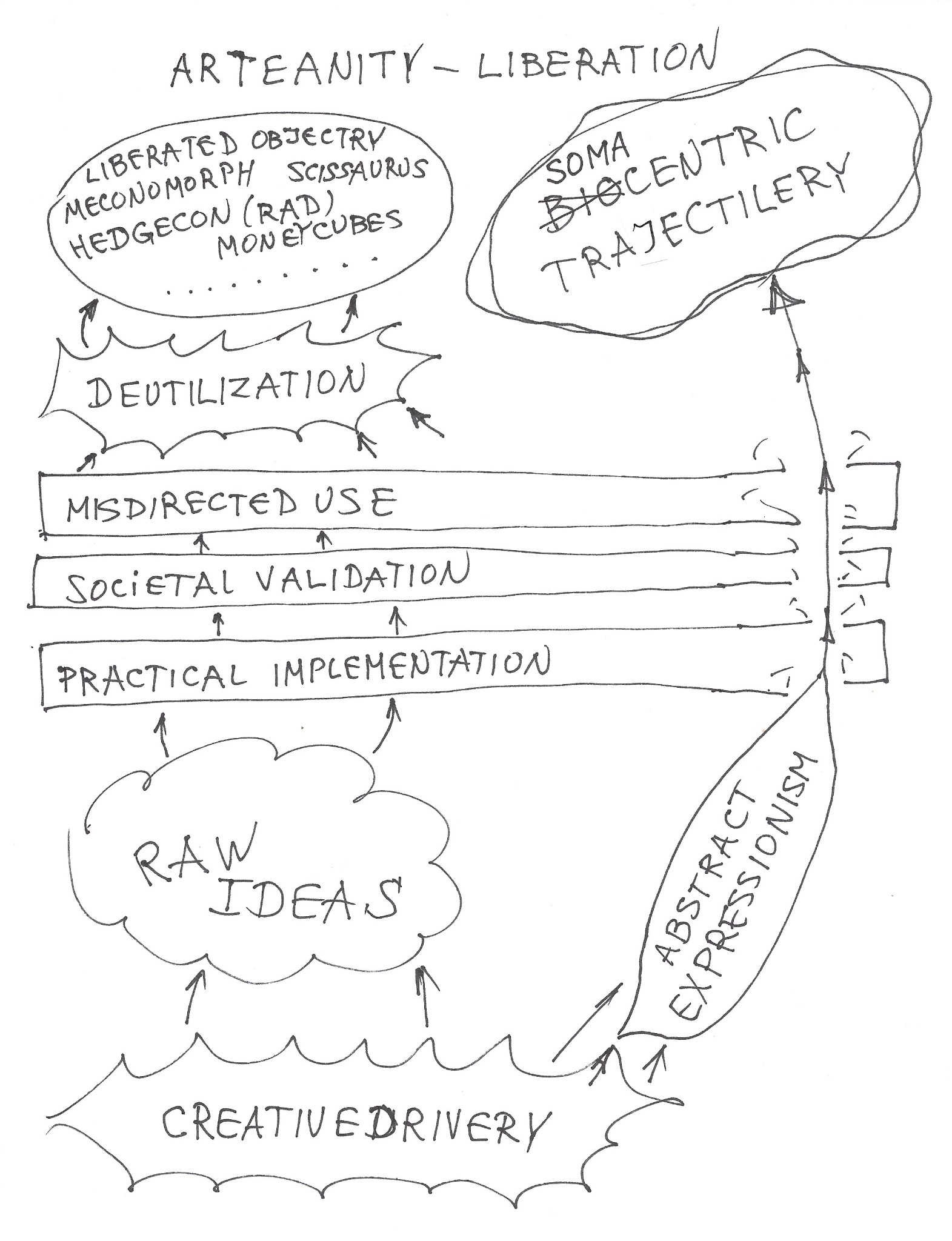
Nameless Number One, dated May 28, 2026, anchors the later practice materially. The image accompanying this essay—the Arteanity liberation diagram—records the artist’s own developing conceptual relations. Neither document proves the psychological comparison. They establish what the comparison must answer to.
Questions for Deeper Investigation
A Connection That Must Remain Open
The strongest outcome of this encounter is not a claim that Maslow anticipated Arteanity in full, or that Arteanity has solved a problem psychology could only describe. It is a more exact question about the authority granted to potential.
Capacity can call for expression. It can also be conscripted by the very language used to celebrate it. Deutilization examines an existing assignment; Preutilization intervenes while a result is still forming; the Geometer preserves the difficulty of crossing that threshold at all. Maslow provides a neighboring inquiry through which these tensions can be considered more carefully.
The comparison remains productive only while disagreement remains possible. A material procedure may illuminate a psychological question without answering it. A psychological concept may make a literary scene newly legible without exhausting it. An independent convergence can be significant without becoming evidence of superiority, inevitability, or historical influence.
Sources, Attribution, and Reading Status
The Maslow references below distinguish material consulted for this draft from reading still required. Online transcriptions contain OCR errors; no uncertain transcription is quoted. Chapter references are used where edition pagination differs. The argument connecting these sources to Arteanity is the interpretation developed in this record, not a position attributed to Maslow.
Arteanity sources: [A1] The Emergence of Somacentric Trajectilery; [A2] Before and After Assignment; [A3] Before Composition: Preutilization, Automatism, and Intention and its linked artifact records; [A4] the Literary Interruption and Primordial Mechanisms branch records; [A5] the City of Chaos artifact record. The underlying project note Arteanity connection preserves the early “RAW to the AWE” formulation; its stronger claims of absolute immediacy are not adopted here as established findings.
Origin of the comparison: the November 7, 2026 artist–AI discussion. This record was drafted with AI assistance from that discussion, current archive records, and the sources identified above, for examination by Viktor Genel. It is not an independent external critical assessment. The date of first encounter with Maslow is Genel’s autobiographical account, not a separately verified historical finding.